
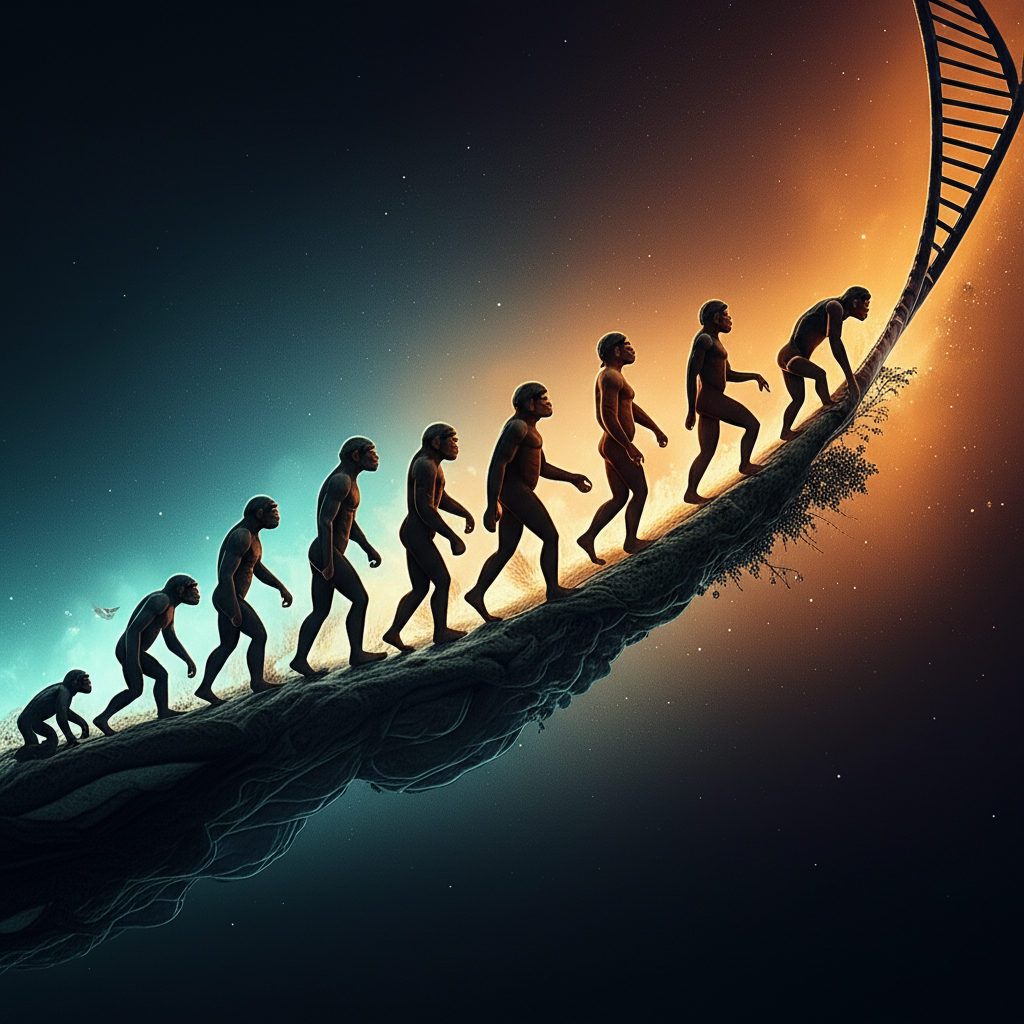
- The Dawn of Bipedalism: Our First Great Leap
- The Rise of the Genus Homo and the Power of Tools
- Masters of the Environment: Homo erectus and the Spread Out of Africa
- Our Close Cousins: Neanderthals and Denisovans
- The Cognitive Revolution: The Birth of Homo sapiens
- The Journey Onward: Modern Human Dispersal and Adaptation
- Unveiling the "How": The Interdisciplinary Approach
How did humans evolve? This quintessential question has captivated thinkers for millennia, driving a spectacular journey of discovery across continents and through the annals of time. While no single, ultimate answer can encapsulate the intricate tapestry of millions of years, modern science has undeniably unveiled a profound narrative, piecing together clues from fossils, ancient tools, genetic codes, and environmental shifts. This isn’t just a story of adaptation; it’s a saga of ingenuity, resilience, and serendipitous circumstance that ultimately led to the complex beings we are today.
The Dawn of Bipedalism: Our First Great Leap
The story of human evolution fundamentally begins with a change in posture. Around 6 to 7 million years ago, in the Miocene epoch, our ancestors in Africa made a monumental shift: they began walking on two legs. This wasn’t an overnight transformation; early hominins like Sahelanthropus, Orrorin, and Ardipithecus show mosaic features, hinting at a transitionary lifestyle that combined arboreal agility with terrestrial bipedalism.
How did this crucial change occur? Several theories attempt to explain the origins of bipedalism. One prominent hypothesis suggests that as forests receded and vast savannas expanded, standing upright offered a distinct advantage. It allowed early hominins to see over tall grasses, spot predators, and locate resources more effectively. Other ideas propose that bipedalism was more energy-efficient for long-distance travel, helped in carrying food or infants, or minimized exposure to the midday sun, aiding in thermoregulation. The fossil record, particularly the famous “Lucy” (Australopithecus afarensis) with her clearly bipedal skeletal structure and the Laetoli footprints, provides compelling evidence of this early upright locomotion, marking a definitive divergence from our chimpanzee-like ancestors.
The Rise of the Genus Homo and the Power of Tools
Roughly 2.8 million years ago, a new lineage emerged, characterized by slightly larger brains and, crucially, a knack for modifying their environment. This was the genus Homo. The earliest member, Homo habilis (“handy man”), is synonymous with the advent of rudimentary stone tools – the Oldowan industry. These simple choppers and flakes, created by striking one stone against another, revolutionized how hominins acquired and processed food.
How did tool-making drive brain development and vice versa? This relationship was a powerful positive feedback loop. Making tools required planning, dexterity, and foresight, all of which stimulated cognitive development. Simultaneously, a larger, more complex brain enabled the creation of more sophisticated tools and strategies. Tools allowed access to new food sources, particularly nutrient-rich bone marrow and meat from carcasses, which provided the energetic demands for a growing brain. This shift in diet, facilitated by sharp stone tools, catalyzed further evolutionary changes, setting the stage for future advancements.
Masters of the Environment: Homo erectus and the Spread Out of Africa
With a larger brain, more advanced tools (Acheulean handaxes), and a fully committed bipedal gait, Homo erectus burst onto the scene around 1.9 million years ago. This species was a true pioneer, becoming the first hominin to leave Africa and spread across Asia and into parts of Europe.
How did Homo erectus manage to spread so far and wide? Their success lay in a combination of factors. They possessed a more efficient form of bipedalism, capable of covering vast distances. Critically, Homo erectus was also the first hominin to harness and control fire. Fire provided warmth, protection from predators, facilitated cooking (which made food easier to digest and increased nutrient absorption), and allowed for social gatherings, potentially extending active hours into the night. These innovations, coupled with increasingly complex social structures, provided an unparalleled adaptive advantage, allowing them to thrive in diverse environments far removed from their African homeland.
Our Close Cousins: Neanderthals and Denisovans
As Homo erectus populations evolved in different regions, other hominin species emerged. In Eurasia, Homo neanderthalensis (Neanderthals) and Denisovans evolved, adapting to the colder climates and challenging landscapes of glacial periods. Neanderthals, known for their robust builds, sophisticated Mousterian tools, and even evidence of ritualistic burials and care for the infirm, were highly intelligent and culturally complex.
Modern genetics has provided astonishing insight into how our species interacted with these cousins. We now know that Homo sapiens, originating in Africa, encountered and interbred with both Neanderthals and Denisovans as they moved out of Africa. Traces of Neanderthal and Denisovan DNA are found in the genomes of most non-Africans today, testifying to a complex and intertwined evolutionary history rather than a simple linear progression.
The Cognitive Revolution: The Birth of Homo sapiens
The appearance of anatomically modern humans, Homo sapiens, in Africa around 300,000 to 200,000 years ago, marks a pivotal moment. While our brains weren’t necessarily bigger than Neanderthals’, they appeared to be organized differently, leading to an explosion of cognitive abilities.
How did these advanced cognitive abilities develop? This “Cognitive Revolution” is believed to be linked to the development of complex symbolic thought, sophisticated language, and an unparalleled capacity for innovation. Evidence from rock art, intricate tools (including blades, spear throwers, and bone tools), personal adornments, and planned burials points to a species capable of abstract thinking, cultural transmission, and deep interpersonal connections. Environmental pressures and social complexity likely played significant roles in selecting for these traits, leading to a species uniquely equipped to adapt and manipulate its surroundings.
The Journey Onward: Modern Human Dispersal and Adaptation
The definitive “Out of Africa” migration of Homo sapiens occurred roughly 60,000 to 70,000 years ago, leading to the rapid colonization of every continent except Antarctica. This journey saw humans adapting to an extraordinary range of environments, from the arctic tundra to tropical rainforests and arid deserts.
How do current genetic studies trace our journey across the globe? Thanks to advancements in DNA sequencing, scientists can analyze mitochondrial DNA (inherited maternally) and Y-chromosome DNA (inherited paternally) from modern populations. These genetic markers act like signposts, revealing the migratory paths of our ancestors, the timing of dispersals, and the genetic mixing events that shaped distinct human populations, all while confirming our recent African origins.
Unveiling the “How”: The Interdisciplinary Approach
The ultimate answers to how humans evolved are not found in one single field but emerge from a dynamic interplay of disciplines. Paleoanthropologists excavate ancient remains, archaeologists study tools and cultural sites, geneticists decode ancestral DNA, climatologists reconstruct past environments, and neuroscientists explore the intricate workings of the human brain. Each piece of the puzzle, meticulously studied and cross-referenced, contributes to our ever-refining understanding.
From the first wobbly steps of our bipedal ancestors to the complex societies and technological marvels of today, human evolution is a story of continuous change, adaptation, and an enduring drive to understand our place in the world. While many mysteries remain, the collective pursuit of knowledge continues to unveil the incredible journey of Homo sapiens, offering profound insights into what it means to be human.
0 Comments