
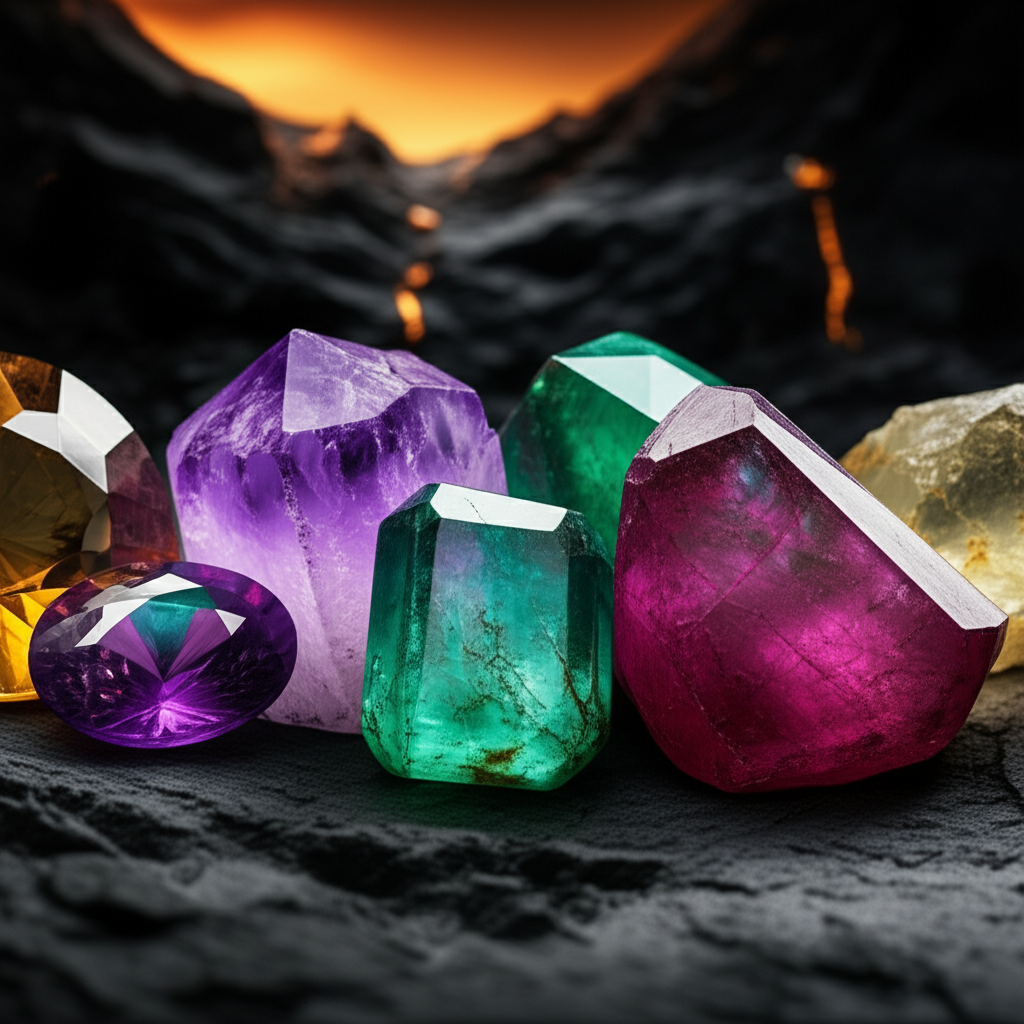
The Fascinating Origin of Gemstones Revealed
The allure of gemstones has captivated humanity for millennia. From the shimmering depths of a sapphire to the fiery dance within a diamond, these natural treasures have adorned royalty, symbolized love, and served as powerful talismans. But before they ever grace a ring or necklace, gemstones embark on an astonishing journey, forged deep within the Earth under conditions of incredible pressure, heat, and time. Understanding their origins reveals not just geological processes, but a profound appreciation for the natural world’s capacity to create breathtaking beauty.
The Deep Earth’s Crucible: Igneous Origins
Many of the most prized gemstones are born from the Earth’s fiery heart, originating from igneous processes. This category includes minerals that crystallize directly from molten rock – magma below the surface, or lava after a volcanic eruption. Diamonds are perhaps the most famous example. Formed from pure carbon, they require immense pressure and temperatures, typically found at depths of 90-120 miles in the Earth’s mantle. They are then brought to the surface quickly through deep-seated volcanic eruptions, housed within characteristic kimberlite or lamproite pipes.
Other igneous gems like peridot are born in volcanic environments. Peridot, the gem-quality variety of the mineral olivine, often crystallizes in magma chambers beneath volcanoes and can be ejected during eruptions, sometimes found in volcanic rocks. Topaz and some garnets also trace their origins back to the cooling and crystallization of specific types of magma, often in pegmatite veins – large-grained igneous rocks that allow crystals ample space to grow to impressive sizes.
Transformation Under Pressure: Metamorphic Origins
Beyond the direct cooling of molten rock, many gemstones owe their existence to metamorphism – the transformation of existing rocks under intense heat, pressure, and chemical alteration without melting. This process can recrystallize minerals, create new ones, and even concentrate trace elements that give gems their vibrant colors.
Rubies and sapphires, both varieties of the mineral corundum, are prime examples of metamorphic gemstones. While they can also have igneous origins, many significant deposits form when aluminum-rich rocks are subjected to incredible heat and pressure deep within the Earth’s crust, often during the formation of mountain ranges. The presence of trace elements like chromium (for ruby’s red) and titanium and iron (for sapphire’s blue) determines their final hue. Similarly, deep green emeralds, a variety of beryl, often form in metamorphic environments where chromium and vanadium-rich fluids interact with beryl-forming hydrothermal systems. Jade, in its two forms – jadeite and nephrite – is another classic metamorphic gem, formed under high pressure and low temperature conditions, often where oceanic plates collide.
The Gentle Hand of Water and Weathering: Sedimentary & Hydrothermal Origins
Not all gemstones require extreme heat and pressure. Some form closer to the Earth’s surface, with water often playing a crucial role. Sedimentary gemstones form when minerals precipitate from water, or when existing minerals are concentrated by sedimentary processes. Opals are a beautiful illustration of this; they form when silica-rich water seeps into cracks and voids in rocks. As the water evaporates, it leaves behind microscopic silica spheres that, over time, compact and harden, creating the opal’s unique play-of-color.
Hydrothermal gems form from hot, chemically active water or fluid circulating through cracks and fissures in rocks. These fluids dissolve minerals from surrounding rocks and then deposit them as they cool or react with other minerals. Quartz varieties like amethyst, citrine, and rock crystal are often formed in hydrothermal veins or geodes. Gold, another highly valued material, also frequently forms in hydrothermal quartz veins. Even some diamonds found in secondary alluvial deposits (riverbeds) are transported there after their primary igneous host rock weathers away, showcasing how water can concentrate treasures.
From Life’s Embrace: Organic Gemstones
Unlike their mineral counterparts, organic gemstones are not born from geological processes but are products of living organisms. These unique materials boast a warmth and history that mineral gems simply cannot replicate.
Pearls, perhaps the most iconic organic gem, are formed within the soft tissue of mollusks like oysters and mussels. When an irritant enters the shell, the mollusk secretes layers of nacre around it as a defense mechanism, gradually building up the lustrous pearl. Amber, another ancient organic gem, is fossilized tree resin. Over millions of years, tree sap hardens and undergoes polymerization, transforming into the golden, often insect-containing, material we cherish. Coral, a skeletal remains of marine polyps, forms vast undersea colonies over centuries, which are then harvested and polished into vibrant red, pink, or white gems. Jet, a dense form of lignite (a precursor to coal), is the fossilized wood of specific trees, formed under pressure and heat from ancient swamps.
The Journey to Our Hands
Regardless of their specific genesis, all gemstones must embark on a final journey to where human hands can discover them. This often involves tectonic uplift, bringing deeply formed rocks closer to the surface, and erosion – the relentless forces of wind, water, and ice that wear away overlying rock, exposing the hidden treasures. Prospectors and miners then painstakingly extract these wonders from primary deposits (where they originally formed) or secondary deposits (where they have been transported and concentrated by natural forces like rivers).
From the intense pressures beneath the Earth’s crust to the gentle whisper of ancient oceans, and even from the very essence of life itself, gemstones are testaments to Earth’s dynamic and creative power. Each gem holds a story billions of years in the making, a silent chronicle of our planet’s incredible past, waiting to be unveiled and admired. Their origins are not just a scientific curiosity, but a profound reminder of the natural world’s enduring magic.
0 Comments