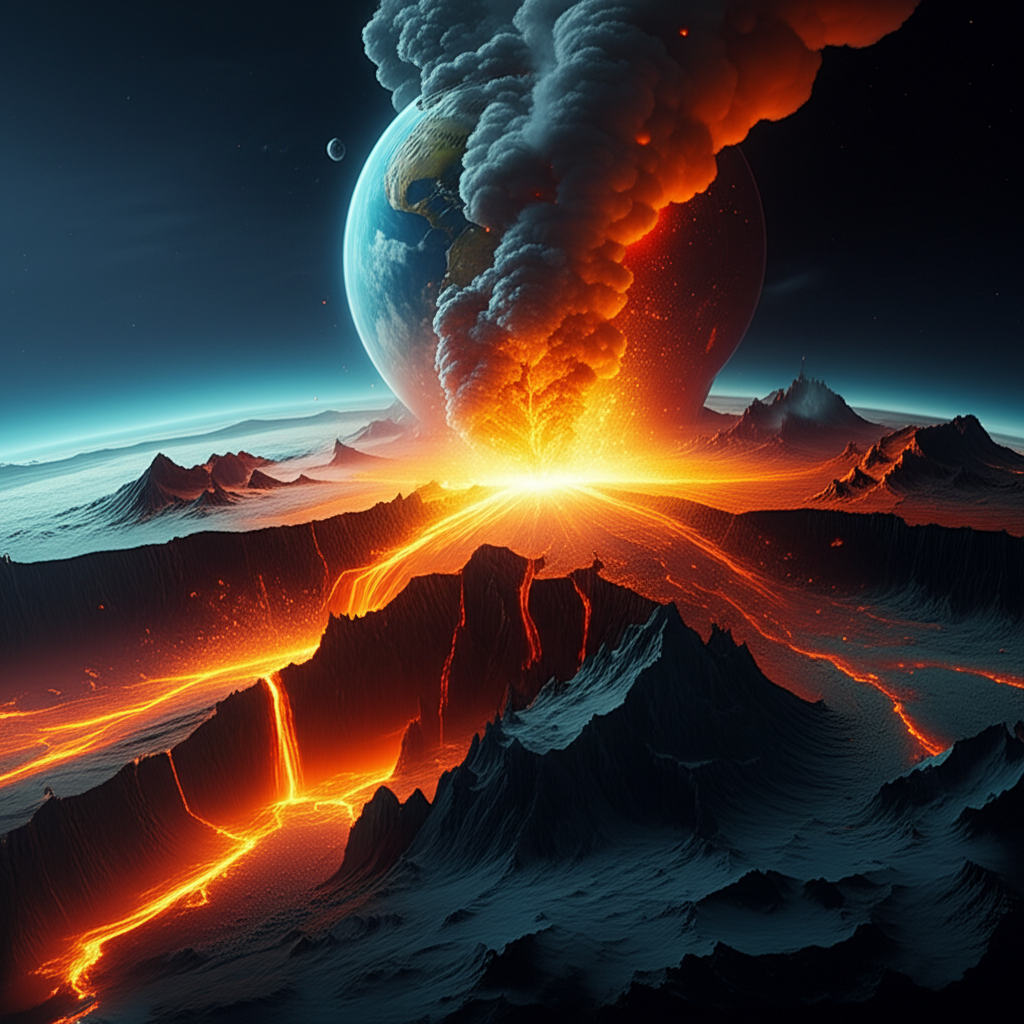
How continents formed is one of Earth’s most captivating geological narratives, a stunning saga spanning billions of years. Our planet, far from being a static ball of rock, is a dynamic entity, constantly reshaping its surface through immense, unseen forces. The familiar landmasses we inhabit today are merely the latest configuration in a long history of continents assembling, breaking apart, and drifting across the globe. Understanding this process requires delving into the deep past, leveraging scientific theories that have revolutionized our comprehension of Earth’s interior and its ever-evolving crust.
The Earth’s Fiery Birth and the First Crust
To grasp continent formation, we must first journey back to Earth’s infancy, some 4.5 billion years ago. Born from a swirling disc of gas and dust, our nascent planet was a molten inferno, gradually cooling over millions of years. Heavier elements like iron and nickel sank to form the core, while lighter silicate materials rose to form the mantle and, eventually, the crust. The very first crust was likely thin, basaltic (oceanic crust-like), and frequently recycled back into the mantle through intense volcanic activity. These earliest proto-continents were small, fragmented landmasses, often referred to as “cratons,” which formed the stable cores around which today’s larger continents accreted.
The Revolutionary Theory of Plate Tectonics
The primary mechanism how continents have formed and moved throughout geological time is the theory of plate tectonics. This paradigm-shifting theory, widely accepted by the scientific community, posits that Earth’s outermost layer, the lithosphere, is broken into several large and dozens of smaller “plates.” These plates, which include both continental and oceanic crust, float atop the semi-fluid asthenosphere, a layer within the upper mantle. Convection currents within the asthenosphere, driven by heat escaping from Earth’s core, act like colossal conveyor belts, slowly but ceaselessly moving these plates across the planet’s surface.
How Plate Boundaries Drive Continental Evolution
The action at the boundaries between these tectonic plates is where the magic of continent formation truly happens:
1. Divergent Boundaries: Here, plates pull apart. Molten magma rises from the mantle to fill the gap, creating new oceanic crust. This process, known as seafloor spreading, is responsible for the formation of vast mid-ocean ridges (like the Mid-Atlantic Ridge) and can also initiate continental rifting, where a continent begins to split apart, eventually leading to new ocean basins. The East African Rift Valley is a prime example of this process in action today.
2. Convergent Boundaries: These are zones where plates collide, leading to some of Earth’s most dramatic geological features.
Oceanic-Continental Collision: The denser oceanic plate is forced beneath the lighter continental plate in a process called subduction. This generates deep ocean trenches, volcanic mountain ranges on the continent (like the Andes), and intense seismic activity. Over geological time, volcanic arcs and sediments can accrete to the continental margin, adding new material.
Oceanic-Oceanic Collision: One oceanic plate subducts beneath another, forming island arc volcanoes (like Japan or the Mariana Islands) and deep trenches. These island arcs can later collide with continents or other island arcs, contributing to continental growth.
* Continental-Continental Collision: When two continental plates collide, neither can subduct significantly due to their similar buoyancy. Instead, the immense compressional forces cause the crust to buckle, fold, and thrust upwards, creating colossal mountain ranges like the Himalayas. These collisions fuse continents together, adding to their size and complexity.
3. Transform Boundaries: Plates slide past each other horizontally (e.g., the San Andreas Fault). While they don’t directly create or destroy crust, they accommodate plate movement and are sources of significant earthquakes, influencing the overall stress regimes that contribute to continental reshaping.
The Supercontinent Cycle: How Our World Keeps Changing
The dynamic interplay of these plate tectonic processes has led to what geologists call the “supercontinent cycle.” Over hundreds of millions of years, continents repeatedly assemble into massive supercontinents and then break apart again. The most famous supercontinent is Pangea, which existed about 335 to 175 million years ago. Before Pangea were Gondwana and Laurasia (which formed Pangea), Rodinia, Pannotia, and likely numerous others we have yet to fully unravel.
The formation of a supercontinent involves the collision and welding together of numerous smaller continental blocks. This often results in extensive mountain-building events (orogenies) and dramatic changes in global climate and ocean circulation. Eventually, the immense insulation provided by a supercontinent can cause heat to build up beneath it, leading to rifting and its eventual breakup, starting the cycle anew. The Atlantic Ocean, for instance, is a direct result of Pangea’s breakup as North America and Eurasia drifted apart.
The Continual Journey
The journey of how continents formed is an ongoing narrative. The continents we know today are still in perpetual motion. The Atlantic Ocean is widening, while the Pacific is slowly shrinking as its oceanic crust is subducted. Africa is gradually converging with Europe, and Australia is moving northward towards Asia. In tens of millions of years, the Earth’s continental arrangement will look markedly different.
From the first fragile crust born of a molten Earth to the majestic mountain ranges and vast ocean basins of today, the formation and evolution of continents represent a grand testament to Earth’s immense internal power. It’s a geological ballet, orchestrated by the slow, inexorable dance of tectonic plates, continuously unveiling new chapters in our planet’s stunning past and its ever-changing future.
0 Comments