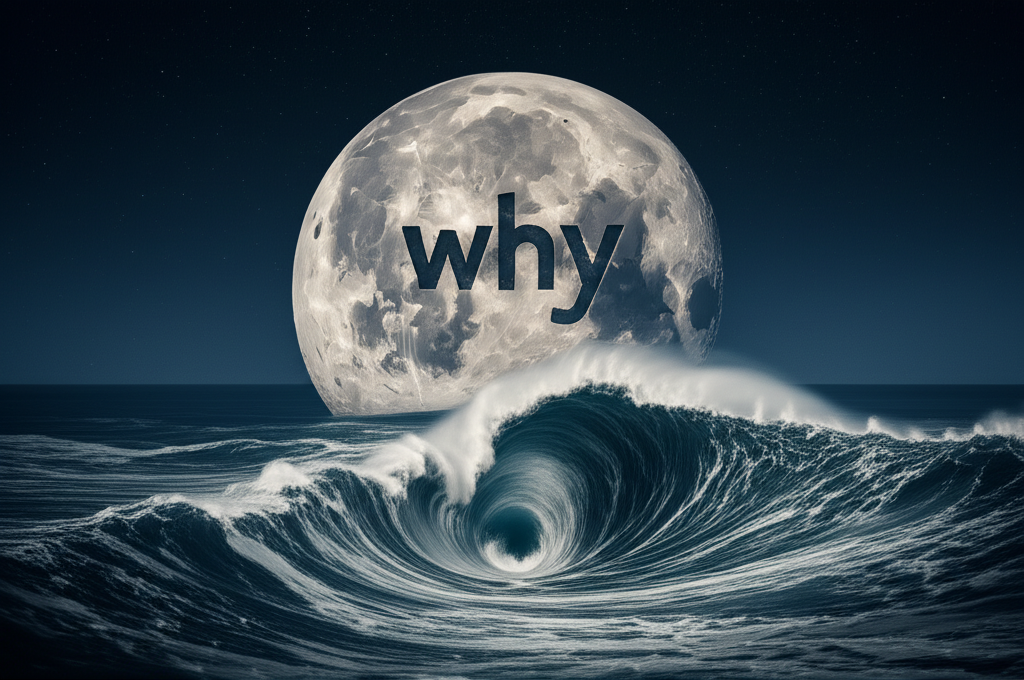
Why does the ocean rise and fall with such predictable regularity, ebbing and flowing in a ceaseless rhythm? For centuries, the mysterious movements of the tides baffled humanity. We now understand that the stunning truth behind this powerful natural phenomenon lies not within Earth itself, but in the gravitational embrace of our closest celestial neighbour: the Moon. It’s a complex interplay of forces, inertia, and the vastness of our oceans, orchestrating one of the most fundamental daily cycles on our planet.
The Invisible Hand: A Gravitational Tug-of-War
At the heart of ocean tides is Isaac Newton’s Law of Universal Gravitation. This fundamental law states that every particle of matter attracts every other particle with a force directly proportional to the product of their masses and inversely proportional to the square of the distance between their centers. While the Sun is far more massive than the Moon, its immense distance means its gravitational influence on Earth’s tides is secondary to that of the Moon.
The Moon exerts a gravitational pull on everything on Earth, including the solid land, the atmosphere, and crucially, the oceans. However, this pull isn’t uniform across our planet. The side of Earth facing the Moon experiences a stronger gravitational tug because it’s slightly closer to the Moon. Conversely, the side of Earth farthest from the Moon experiences a weaker pull. This difference in gravitational force, known as the tidal force, is the key to understanding how tides are formed.
Creating the Bulges: Two Sides of the Same Coin
Imagine the Earth covered entirely in water. The Moon’s gravity directly pulls the water on the side of Earth closest to it, creating a “bulge” of water. This is our first high tide.
Now, consider the opposite side of Earth. It’s farther from the Moon, so the Moon’s gravitational pull on it is weaker. Instead of pulling the water away, the Moon’s gravity is pulling the solid Earth itself away from the water on the far side. Think of it like this: the Moon is pulling the Earth’s center away from the loosely held water on the far side, leaving that water to bulge outwards due to its own inertia. This creates a second high tide on the side of Earth opposite the Moon.
In summary, the Moon acts like a giant celestial hand, directly pulling water towards it on one side of Earth, and effectively pulling the Earth away from the water on the opposite side. The areas between these two bulges experience lower water levels, creating low tides.
Why Two High Tides a Day?
This is a common question, and the answer lies in understanding these two distinct bulges. As Earth rotates on its axis approximately every 24 hours, any given location on our planet will pass through both of these tidal bulges.
During a 24-hour cycle, a coastline will directly align with the Moon’s gravitational pull, experiencing a high tide. Approximately 12 hours and 25 minutes later, that same coastline will have rotated to the opposite side of Earth, passing through the second high tide bulge caused by the Earth being pulled away from the water. In the intervening six-hour periods, the location passes through the areas of low water, resulting in low tides. This is why most places experience two high tides and two low tides roughly every lunar day (which is about 24 hours and 50 minutes, slightly longer than a solar day because the Moon also orbits Earth).
The Sun’s Supporting Role: Spring and Neap Tides
While the Moon is the primary driver, the Sun also exerts a gravitational influence on Earth’s oceans. Its effect is about half as strong as the Moon’s due to its much greater distance. However, when the Sun and Moon align, their gravitational forces combine or counteract each other, leading to variations in tidal range.
Spring Tides: These are exceptionally high high tides and very low low tides. They occur when the Sun, Earth, and Moon are roughly in a straight line. This happens during the new moon and full moon phases. In these configurations, the gravitational pulls of the Sun and Moon work together, reinforcing the tidal bulges and creating more extreme tides. The name “spring” has nothing to do with the season; it comes from the Old English word “springen,” meaning to rise or burst forth.
Neap Tides: These are weaker tides, characterized by lower high tides and higher low tides. They occur when the Sun and Moon are at right angles to each other relative to Earth. This happens during the first and last quarter moon phases. In this arrangement, the Sun’s gravity works against the Moon’s, effectively cancelling out some of the tidal forces and resulting in less pronounced bulges.
Beyond Celestial Mechanics: Other Factors at Play
While gravity is the fundamental driver, several other factors modify the tidal patterns we observe:
1. Ocean Basin Topography: The shape of coastlines, the depth of the ocean floor, and the configuration of continents significantly restrict and channel tidal flows. Narrowing bays or estuaries can amplify tidal ranges, sometimes dramatically. The Bay of Fundy in Canada, for example, is famous for having the highest tides in the world, with differences of up to 16 meters, largely due to its funnel shape.
2. Coriolis Effect: As tidal waves move across the oceans, they are influenced by Earth’s rotation, which introduces a deflecting force known as the Coriolis effect. This can cause tidal waves to swirl in basins rather than simply moving straight back and forth.
3. Resonance: Ocean basins have natural frequencies at which water in them tends to oscillate. If the frequency of the tidal forcing matches a basin’s natural resonant frequency, the tides can be greatly amplified.
4. Atmospheric Pressure and Winds: Local weather conditions, such as strong onshore winds or areas of high or low atmospheric pressure, can cause minor, temporary changes in sea level, influencing the observed tidal heights.
A Dance of Cosmic Proportions
The Moon’s stunning truth, its unyielding gravitational presence, drives the majestic dance of our ocean tides. From the simple gravitational pull that creates the initial bulges to the complex interplay with the Sun, Earth’s rotation, and geographical features, tides are a testament to the interconnectedness of our solar system. This constant ebb and flow not only shapes our coastlines but also plays a vital role in marine ecosystems, influencing everything from the spawning cycles of fish to the feeding patterns of shorebirds. It’s a daily, undeniable reminder of our planet’s deep connection to the cosmos, a celestial spectacle played out on every shoreline.
0 Comments