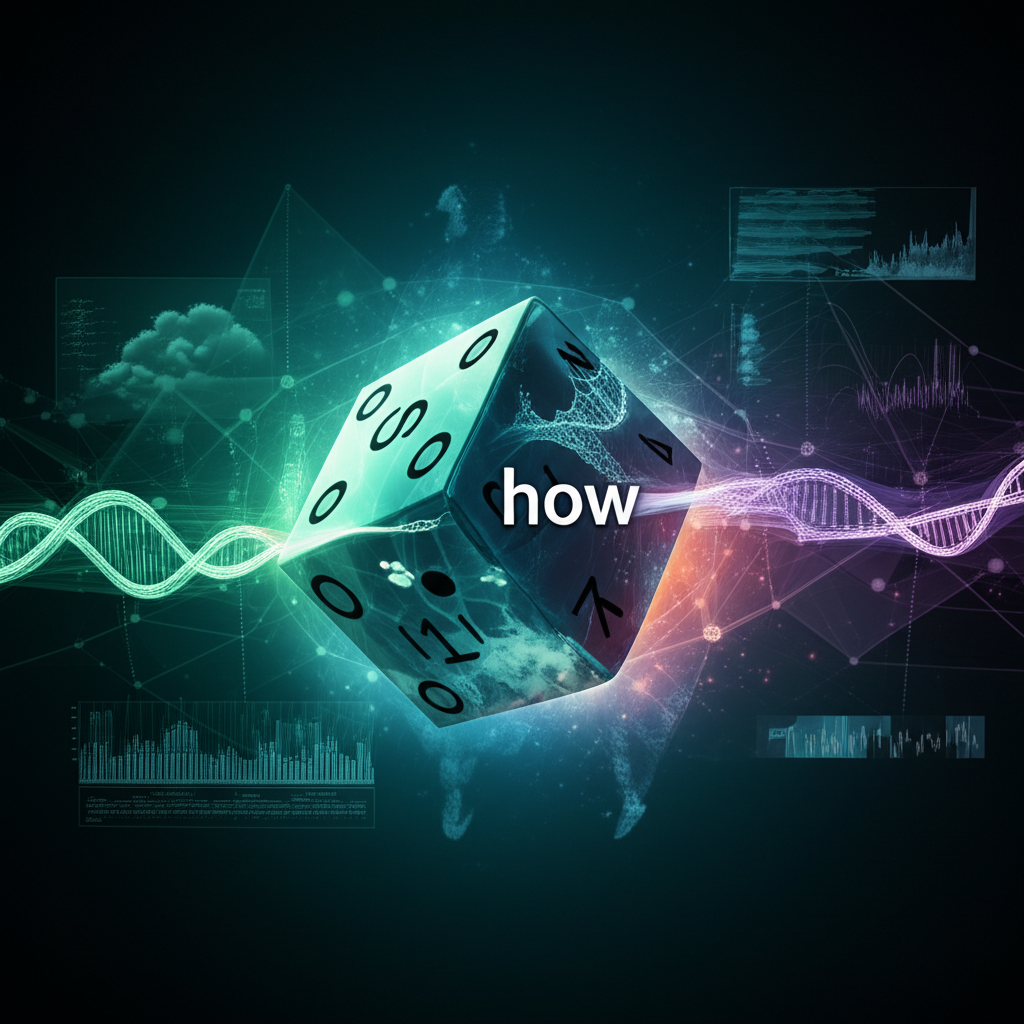
How does the seemingly abstract world of probability unlock the vital secrets of our universe? From the roll of a die to the intricate dance of subatomic particles, and from predicting stock market fluctuations to understanding the spread of diseases, probability is the silent, ubiquitous language through which we quantify uncertainty and make sense of the world. It’s not just a mathematical concept; it’s a powerful lens through which scientists, engineers, economists, and even everyday individuals extract meaning from chaos, revealing patterns and guiding decisions that shape our future.
At its core, probability is the measure of the likelihood that an event will occur. Expressed as a number between 0 and 1 (or 0% and 100%), it quantifies the degree of certainty or uncertainty. A probability of 0 means the event is impossible, while a probability of 1 means it’s certain. Everything in between represents varying degrees of possibility. While its origins might be tied to games of chance, its application has exploded far beyond the casino, becoming indispensable across virtually all fields of human endeavor.
How Probability Shapes Our Daily Lives
You might not consciously think about probability every day, but it’s constantly at play, influencing countless decisions and systems that affect us. Consider the weather forecast: meteorologists use complex probabilistic models based on atmospheric data to predict the chance of rain tomorrow. This isn’t a definitive statement, but a likelihood that allows us to decide whether to carry an umbrella.
In healthcare, doctors assess the probability of a certain diagnosis based on symptoms and test results, or the probability of success for a particular treatment. Insurance companies, too, are built entirely on probabilistic calculations, assessing the risk of accidents, illness, or property damage to determine premiums. Even in traffic, autonomous vehicles use real-time probabilistic calculations to predict the movement of other cars and pedestrians, making split-second decisions for safety. Whether you’re choosing a lottery ticket or deciding which route to take to avoid traffic, you’re implicitly engaging with probabilistic thinking.
From Ancient Roots to Modern Marvels: The Evolution of Probability
The formal study of probability can be traced back to the 17th century, spurred by a correspondence between French mathematicians Pierre de Fermat and Blaise Pascal regarding problems in games of chance. Their work laid the groundwork for what would become a cornerstone of modern mathematics. Over centuries, geniuses like Abraham de Moivre, Pierre-Simon Laplace, and Andrey Kolmogorov expanded the theories, providing the rigorous framework we use today.
Fast forward to the 21st century, and probability theory is the engine behind artificial intelligence and machine learning. Algorithms that power facial recognition, spam filters, recommendation systems (like those on Netflix or Amazon), and natural language processing heavily rely on probabilistic models. They learn from vast datasets, identifying statistical patterns and making predictions about new, unseen data – all governed by the principles of probability.
How Probability Drives Scientific Discovery and Innovation
Beyond daily applications, probability is perhaps most profoundly felt in its capacity to drive scientific progress. In physics, quantum mechanics, which describes the behavior of matter and energy at the atomic and subatomic levels, is inherently probabilistic. We can’t predict the exact position of an electron, but we can calculate the probability of finding it in a particular region. This understanding has led to revolutionary technologies, from lasers to transistors.
In biology and genetics, probability is crucial for understanding inheritance patterns, genetic mutations, and the spread of infectious diseases. Epidemiologists use probabilistic models to forecast outbreaks, assess risk factors, and evaluate the effectiveness of interventions like vaccines. Clinical trials for new drugs rely heavily on statistical analysis rooted in probability to determine if a treatment is genuinely effective or if observed improvements are simply due to chance.
Economists and financial analysts use probabilistic models to forecast market trends, assess investment risks, and manage portfolios. Understanding the probability of different outcomes allows for more informed decision-making in volatile financial landscapes. Even in fields like archaeology and linguistics, probabilistic methods help interpret incomplete data, reconstruct ancient languages, or pinpoint the most likely origins of historical artifacts.
The Power of Quantifying Uncertainty
The true power of probability lies in its ability to quantify uncertainty, turning vague intuitions into precise calculations. We live in a world brimming with randomness and incomplete information. Probability offers a systematic way to navigate this complexity, allowing us to:
Make informed decisions: By weighing the likelihood of various outcomes, we can choose courses of action that maximize desired results and minimize risks.
Predict future events: While not deterministic, probabilistic predictions offer valuable insights into potential future scenarios.
Understand and manage risk: From personal health to global pandemics, probability helps us assess, understand, and mitigate risks effectively.
Extract patterns from data: In an age of big data, probability and statistics are the essential tools for uncovering hidden relationships and trends.
In essence, probability allows us to move beyond guesswork. It provides the mathematical framework for understanding the unknown, estimating the chances of different outcomes, and thereby making more rational, data-driven decisions. It is the invisible key that continues to unlock a deeper understanding of the vital secrets woven into the fabric of our existence, empowering us to better predict, plan, and innovate in an ever-complex world.
0 Comments