Why does ice float? It’s a question that might seem simple, yet its answer unveils one of nature’s most peculiar and profound scientific truths. On the surface, it feels counter-intuitive: most substances become denser when they solidify, meaning their solid form sinks in their liquid form. Think of solidified candle wax sinking in molten wax, or a metal spoon sinking in a crucible of its molten counterpart. Water, however, defies this norm, and this unique property is not just a quirky anomaly; it’s a fundamental characteristic that underpins life on Earth as we know it.
The Unusual Case of Water
To understand why ice floats, we first need to appreciate what makes water (H₂O) such an unusual molecule. Water is a polar molecule, meaning it has a slight positive charge on its hydrogen atoms and a slight negative charge on its oxygen atom. This uneven distribution of charge allows individual water molecules to form attractive forces with neighboring molecules, known as “hydrogen bonds.” These bonds are crucial to water’s unique properties.
In its liquid state, water molecules are constantly moving, breaking, and reforming hydrogen bonds. This dynamic dance allows them to pack relatively closely together. While hydrogen bonds are present, they are fleeting, enabling the molecules to slide past one another and fill space efficiently. At its densest point, around 4°C (39°F), liquid water achieves its maximal packing.
Why Does Water Expand When It Freezes?
As water cools further, approaching its freezing point of 0°C (32°F), the kinetic energy of the molecules decreases. The hydrogen bonds, which were once flexible and temporary, begin to stabilize and become more rigid. Instead of haphazardly packing together, water molecules arrange themselves into a highly ordered, crystalline lattice structure. The most stable arrangement for these hydrogen bonds in ice is a hexagonal, open framework.
Imagine a group of people forming a very structured dance, holding hands at arm’s length. This open, ordered arrangement means that the molecules are actually less densely packed than they are in liquid water. There are more empty spaces, or “voids,” within the structure of ice compared to the more compressed arrangement of liquid water molecules. For a given mass of water, when it transitions from liquid to solid, its volume increases.
The Critical Density Difference
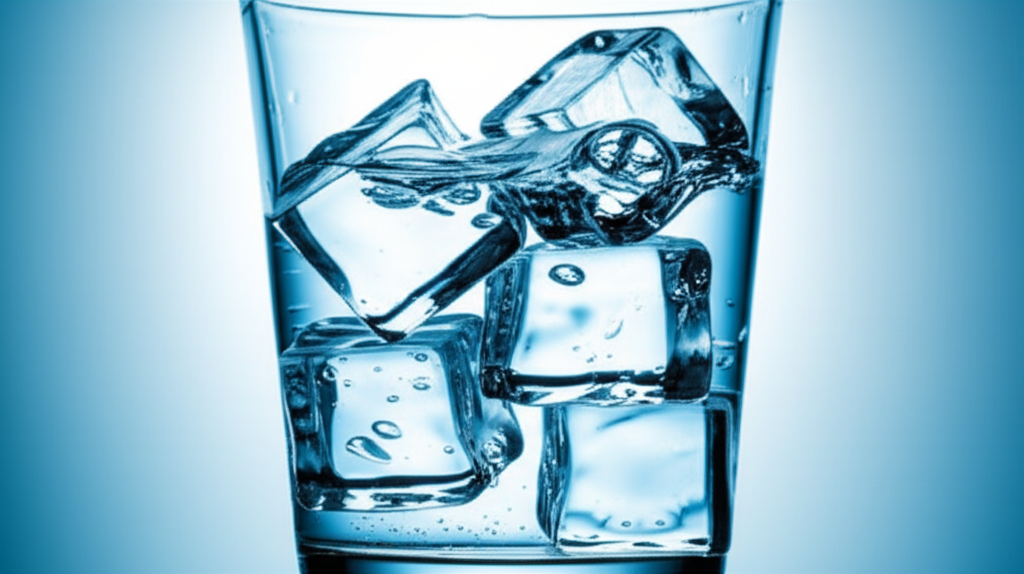
It is this expansion into a more open structure that makes ice less dense than liquid water. Specifically, liquid water at 0°C has a density of approximately 1.000 g/cm³, while ice at 0°C has a density of about 0.917 g/cm³. Because density is defined as mass per unit volume, a substance with a lower density will float on a substance with a higher density. This is Archimedes’ Principle in action, explaining precisely why an ice cube bobs to the surface of your drink, and why colossal icebergs sail the oceans.
Why This Molecular Anomaly Matters So Much
The floating of ice is far more than a scientific curiosity; it is a profound characteristic that has shaped, and continues to sustain, life on Earth. Its implications are vast and far-reaching:
1. Survival of Aquatic Life: If ice were to sink, lakes, rivers, and even oceans in colder climates would freeze from the bottom up. As ice formed and sank, it would insulate the water below it less effectively, allowing more ice to form. Eventually, entire bodies of water could freeze solid, destroying aquatic ecosystems. Because ice floats, it forms an insulating layer on the surface, protecting the underlying water and allowing fish, plants, and other organisms to survive the winter.
2. Regulation of Earth’s Climate: Ice plays a critical role in regulating global temperatures. Polar ice caps and glaciers reflect a significant portion of the sun’s energy back into space, helping to keep the planet cool. This “albedo effect” is vital for preventing Earth from overheating.
3. Weather Patterns and Ocean Currents: The formation and melting of ice influence ocean currents, which distribute heat around the globe, impacting weather patterns and climates across continents.
4. Geological Processes: The expansion of water upon freezing is also responsible for “frost wedging,” a process where water seeps into cracks in rocks, freezes, expands, and widens those cracks, contributing to erosion and the formation of soil.
The Simple, Stunning Truth
In essence, the “simple, stunning truth” of why ice floats lies in the unique geometry of the water molecule and the hydrogen bonds it forms. This forces water molecules into an open, hexagonal crystalline structure when frozen, making solid ice less dense than its liquid form. What appears to be a minor deviation from the norm is, in fact, a critical feature of our planet, demonstrating how the microscopic world of molecular interactions can have macro-level consequences that govern life itself. It’s a beautiful example of how fundamental science explains the world around us, revealing complexity and necessity in what at first seems merely anomalous.
0 Comments