
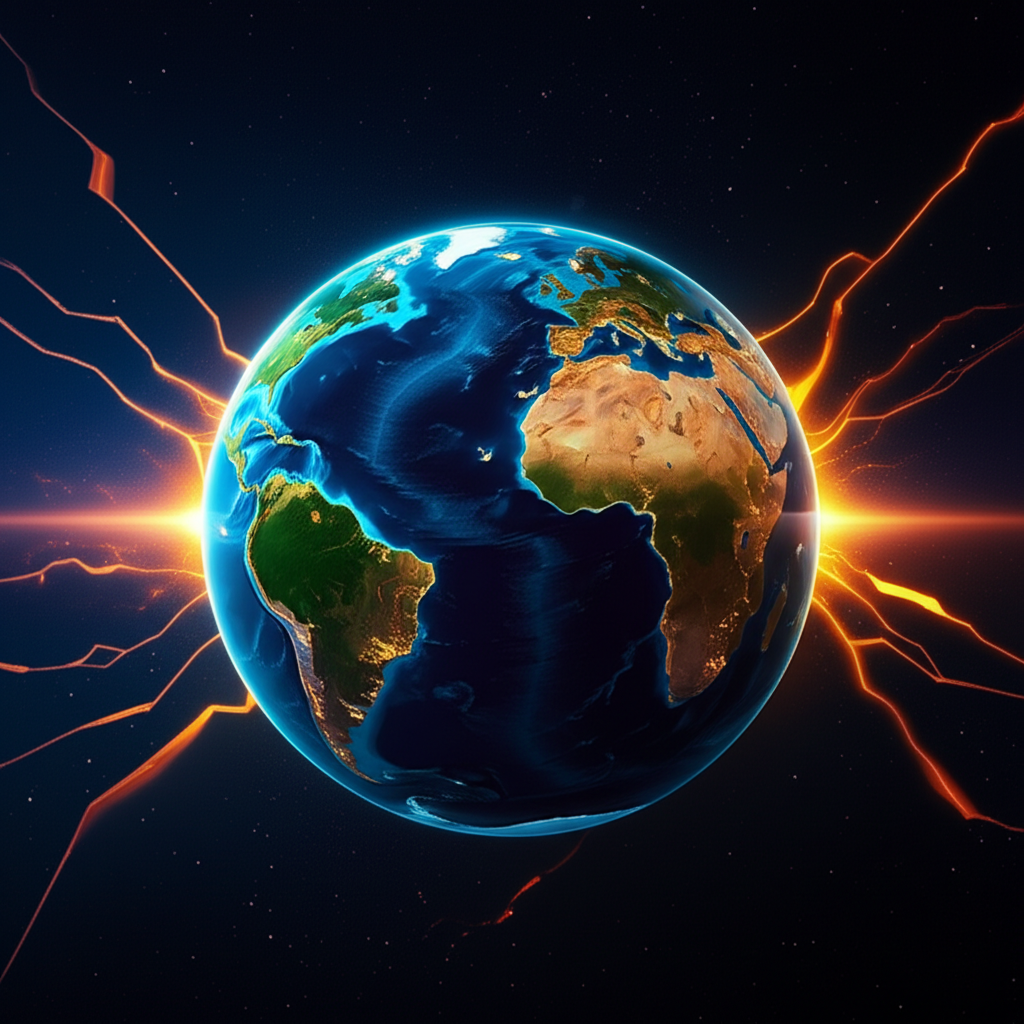
How did the colossal landmasses beneath our feet come into being? Delving into the deep-seated history of our planet reveals a majestic tale of unimaginable forces, immense time scales, and a continuous geological drama that has shaped Earth’s surface for billions of years. The formation of continents is one of Earth’s most amazing secrets, a process that is both fundamental to life as we know it and still actively unfolding around us.
The Molten Cradle: Earth’s Fiery Beginnings
Our story begins more than 4.5 billion years ago, with a young Earth still a molten ball of rock, searing hot and constantly bombarded by asteroids. As the planet gradually cooled, heavier elements like iron and nickel sank to form the core, while lighter silicate materials rose to form the mantle and eventually the first crust. This initial solid surface was vastly different from today’s diverse continental tapestry. It was likely thin, basaltic, and resembled modern oceanic crust, constantly being recycled through volcanism.
The differentiation of Earth’s layers was crucial. Water, introduced by comets and outgassing from volcanic activity, eventually condensed to form the oceans. This interaction between the nascent crust, the vast amounts of water, and the immense heat from Earth’s interior set the stage for the creation of something truly unique: continental crust. Unlike the dense, dark oceanic crust, continental crust is lighter, thicker, and richer in silica, allowing it to “float” higher on the mantle.
How Earth’s First Crust Began
The very first patches of stable, felsic (silica-rich) continental crust are thought to have emerged in a process called differentiation. As oceanic crust was repeatedly subducted into the mantle, partial melting occurred at these zones. Lighter, more buoyant magmas, enriched in silica and other ‘incompatible’ elements that didn’t fit easily into the crystal structures of common mantle minerals, rose to the surface. These magmas solidified to form protocontinents – small, granitic landmasses known as cratons. These ancient, incredibly stable cores are the true bedrock of our continents, and some fragments, like those found in the Canadian Shield or western Australia, date back over 3.8 billion years. Over eons, these cratons would serve as the foundational building blocks for larger landmasses.
How Plate Tectonics Drives Continental Assembly
The true conductor of this geological orchestra is plate tectonics. Earth’s outermost layer, the lithosphere, is broken into several enormous, rigid plates that are constantly in motion, driven by convection currents within the semi-fluid asthenosphere below. These plates move at speeds comparable to the growth of a fingernail, but over millions and billions of years, these seemingly slow movements have profound consequences.
There are three primary types of plate boundaries, each playing a vital role in continental formation:
Divergent Boundaries: Plates move apart, as seen at mid-ocean ridges. Here, new oceanic crust is generated as magma rises from the mantle. While not directly forming continental crust, this process drives the overall plate movement.
Convergent Boundaries: Plates collide. This is where continents are truly forged or reshaped.
When oceanic crust subducts beneath another oceanic plate or a continental plate, it melts, generating new silicic magmas that rise to form volcanic island arcs or mountain ranges along continental margins (e.g., the Andes).
When two continental plates collide, neither can easily subduct due to their buoyancy. Instead, the crust crumples, thickens, and folds, creating immense mountain ranges like the Himalayas – a testament to the ongoing collision of the Indian and Eurasian plates. This process is called orogenesis, or mountain building.
Transform Boundaries: Plates slide past each other horizontally (e.g., the San Andreas Fault). While they don’t directly create or destroy crust, they accommodate movement and can contribute to the shaping of continental edges.
Through repeated cycles of subduction, magmatism, and collision, continents slowly grew, accreting smaller terranes (fragments of crust) and island arcs onto their existing margins.
The Supercontinent Cycle: Earth’s Grand Ballroom Dance
Continents are not fixed entities. For billions of years, they have been engaged in a stately, slow-motion dance across the globe, periodically colliding to form massive supercontinents, only to rift apart and drift to new positions. This phenomenon is known as the supercontinent cycle.
Scientists have reconstructed several ancient supercontinents, including:
Pangea (formed ~335 million years ago): Perhaps the most famous, Pangea grouped nearly all of Earth’s landmasses into one giant continent, significantly impacting global climate, ocean currents, and the evolution of life.
Rodinia (formed ~1 billion years ago): An even older supercontinent whose breakup is linked to major shifts in ocean chemistry and the rise of complex multicellular life.
Columbia (Nuna) (formed ~1.8 billion years ago): Thought to be one of the oldest and largest supercontinents.
The assembly and breakup of these supercontinents are driven by the same forces of plate tectonics, influencing everything from sea levels and glacial cycles to the distribution of species and the stability of global ecosystems. Each cycle of convergence and divergence leaves its geological fingerprints on the continents we see today.
Continents: An Ever-Evolving Canvas
The journey of continental formation is far from over. Today, continents continue their slow but relentless migration. The Atlantic Ocean is widening as the Americas drift westward, while the Pacific Ocean is slowly shrinking. Africa is gradually splitting along the East African Rift Valley, destined to form a new ocean basin in millions of years. Geologists even project the formation of a future supercontinent, perhaps dubbed “Amasia” or “Pangea Ultima,” in another 200-250 million years.
The amazing secrets of how continents formed reveal an Earth that is intensely dynamic and alive. From coalescing dust to towering mountain ranges, the story of continents is a testament to the immense power of geological forces and an enduring reminder of our planet’s ceaseless evolution. Each rock, each mountain range, and each ocean basin holds clues to this epic saga, offering us a glimpse into the profound geological processes that continue to shape our world.
0 Comments