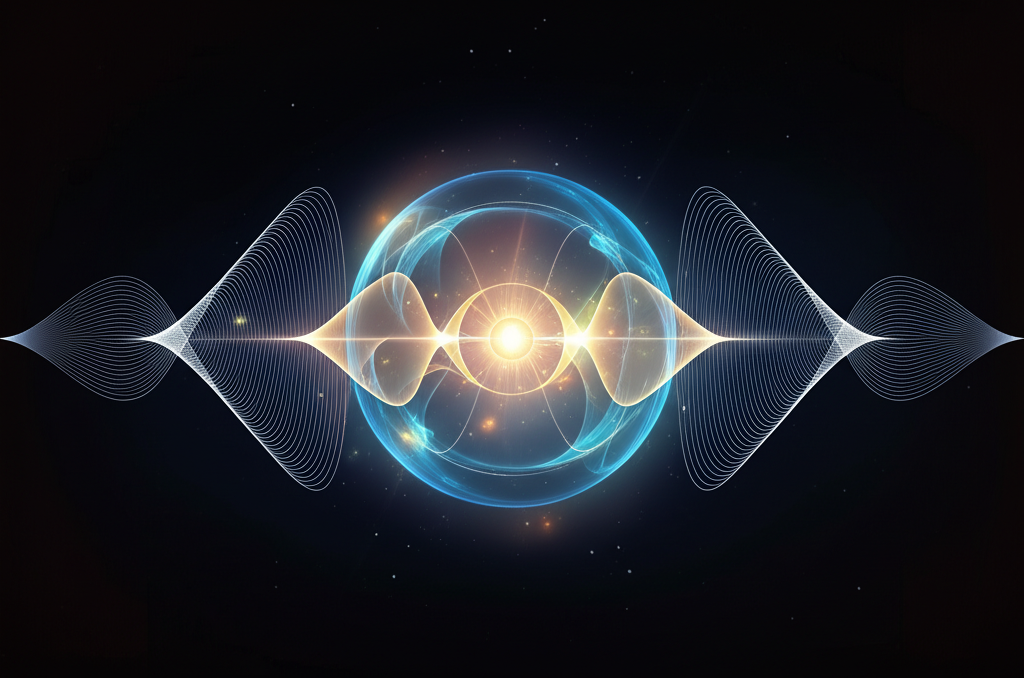
The fabric of our universe, once thought to be built upon clear, distinct principles, reveals its most profound and startling secret through the phenomenon known as wave-particle duality. This isn’t just a scientific curiosity; it’s a fundamental truth that shatters our classical perceptions of reality, forcing us to re-evaluate what we consider “real.” At its core, wave-particle duality asserts that every particle or quantum entity may be described as either a particle or a wave, and sometimes both, defying simple categorization. It’s a cornerstone of quantum mechanics, challenging intuition and opening doors to a universe far more mysterious and fascinating than ever imagined.
Understanding the Classical View of Reality
Before delving into the mind-bending world of quantum duality, it’s essential to grasp the classical understanding that preceded it. For centuries, scientists viewed the universe through a lens of clear distinctions. Matter, composed of particles like atoms, protons, and electrons, possessed definite properties: a specific location, momentum, and mass. These particles were distinct, localized entities that occupied a finite space. On the other hand, energy manifested as waves—like light, sound, or ripples on water—characterized by properties such as wavelength, frequency, and amplitude. Waves spread out, exhibited phenomena like interference and diffraction, and lacked definite positional boundaries. The two categories were mutually exclusive; something was either a wave or a particle, never both. This clear-cut differentiation formed the bedrock of classical physics, dictating how we perceived everything from a billiard ball’s trajectory to the propagation of light across the cosmos.
Exploring the Dual Nature of Light
The first cracks in this rigid classical edifice appeared with light itself. For centuries, a debate raged: was light a stream of particles (as Isaac Newton famously argued) or a wave (as Christiaan Huygens proposed)? Thomas Young’s double-slit experiment in the early 19th century seemed to settle the matter conclusively in favor of waves. When light passed through two narrow slits, it created an interference pattern on a screen behind them—a hallmark of waves interacting and superimposing.
However, the turn of the 20th century brought new revelations that once again challenged this understanding. Max Planck’s work on black-body radiation necessitated the idea that energy is emitted and absorbed in discrete packets, or “quanta.” Albert Einstein then famously applied this concept to explain the photoelectric effect, demonstrating that light, when interacting with matter, behaves as if it consists of discrete particles of energy, which we now call photons. These photons have no rest mass but carry momentum and energy. Thus, light, the quintessential wave, was also shown to possess particle-like properties. This marked the reluctant acceptance of the dual nature of light, a shocking revelation at the time.
Particles Behaving Like Waves: De Broglie’s Hypothesis
If light, a wave, could exhibit particle-like behavior, then perhaps particles could also exhibit wave-like behavior? This audacious proposition came from French physicist Louis de Broglie in 1924. Building on Einstein’s work, de Broglie hypothesized that all matter possesses wave-like properties, and a particle’s wavelength (now known as the de Broglie wavelength) is inversely proportional to its momentum. The idea was initially met with skepticism; after all, we experience particles like baseballs and cars as solid, localized objects, not spreading waves.
Yet, experiments soon validated de Broglie’s radical insight. In 1927, Clinton Davisson and Lester Germer, and independently G.P. Thomson, demonstrated that electrons—definite particles—exhibited diffraction patterns similar to X-rays when scattered by a crystal lattice. This was irrefutable evidence of the electron’s wave nature. Since then, wave-like behavior has been observed for atoms, molecules, and even complex organic molecules, confirming that wave-particle duality is a universal characteristic of matter at the quantum level.
Deciphering the Double-Slit Mystery (Again)
Perhaps the most iconic and perplexing demonstration of wave-particle duality is the double-slit experiment, revisited with individual particles like electrons. When electrons are fired one by one at a screen with two slits, one might expect them to pass through one slit or the other, creating two distinct bands on the detector screen, much like tiny bullets. However, what emerges, over time, is an interference pattern—the same pattern observed with waves. This suggests that each individual electron somehow interferes with itself, traversing both slits simultaneously in its wave-like form.
The mystery deepens when we try to observe which slit the electron goes through. If a detector is placed at the slits to determine the path taken by the electron, the interference pattern vanishes, and the electrons behave like particles, forming two distinct bands. The act of measurement seemingly forces the electron to “choose” one path, collapsing its wave function. This “observer effect” indicates that a quantum entity doesn’t have a definite state (wave or particle, specific location or momentum) until it is observed or measured. Reality, at its most fundamental level, is fluid and interdependent on observation.
Pondering the Profound Implications
Wave-particle duality isn’t merely a quirky anomaly; it profoundly reshapes our understanding of the universe. It tells us that reality isn’t composed of simple, distinct entities. Instead, everything in the quantum realm exists in a state of potentiality, embodying contradictory properties simultaneously, until an interaction or observation “forces” it into a particular manifestation. This leads to the baffling conclusion that there is no single, objective reality independent of observation, challenging centuries of philosophical and scientific thought.
This duality is not just an abstract concept; it has tangible implications. It underpins the very existence of quantum computing, where qubits can exist in multiple states simultaneously (superposition), allowing for parallel computations that classical computers cannot achieve. It’s crucial for understanding quantum entanglement, where particles remain connected regardless of distance, and for developing technologies like electron microscopes.
In essence, wave-particle duality is a testament to the fact that our classical intuition often fails us at the quantum scale. What began as a shocking paradox has evolved into a foundational principle, reminding us that the universe is far stranger, more nuanced, and infinitely more intriguing than we could have ever imagined. It invites us to embrace the ambiguity and wonder inherent in the very fabric of existence.
0 Comments