The captivating arc of a rainbow stretching across the sky is one of nature’s most breathtaking spectacles. For centuries, this vibrant display has inspired awe and wonder, fueling myths and legends across cultures. While its beauty might seem utterly magical, the science behind a rainbow is a testament to the elegant laws of physics governing light and water. Understanding these principles doesn’t diminish the wonder; instead, it deepens our appreciation for this ephemeral masterpiece. Let’s embark on a journey to unravel the incredible physics that transforms sunlight and raindrops into a dazzling spectrum of colors.
What is a Rainbow, Exactly?
Before diving into the intricate physics, it’s crucial to understand that a rainbow isn’t a physical object you can touch or find. It’s an optical illusion, a fleeting meteorological phenomenon that only exists from a specific vantage point. Essentially, a rainbow is the result of sunlight interacting with water droplets in the Earth’s atmosphere, creating a spectrum of light that appears as an arc. To witness a rainbow, you need two primary ingredients: sunlight behind you and water droplets (rain, mist, or even a sprinkler spray) in front of you.
Sunlight: The Canvas for Colors
The story of a rainbow begins with sunlight. We perceive sunlight, or “white light,” as colorless; however, it’s actually a composite of all the colors of the visible spectrum. Isaac Newton famously demonstrated this in the 17th century when he passed white light through a prism, splitting it into its constituent colors: red, orange, yellow, green, blue, indigo, and violet (ROYGBIV). Each of these colors corresponds to a different wavelength of light. It’s the unique properties of these different wavelengths that allow a rainbow to paint its vivid bands across the sky.
Water Droplets: Tiny Prisms in the Sky
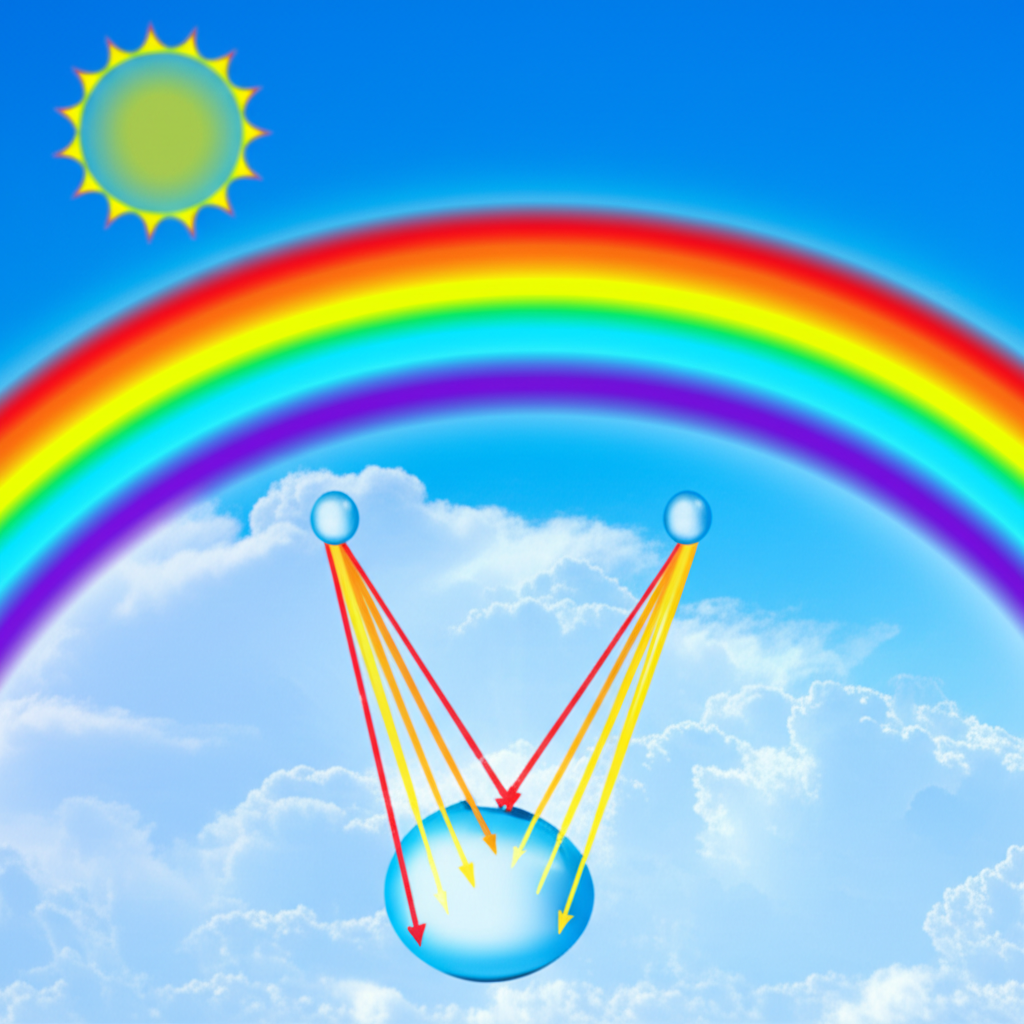
The unsung heroes of the rainbow phenomenon are the countless spherical water droplets suspended in the air. Each raindrop acts as a miniature prism and mirror, performing a precise dance with the sunlight that strikes it. When sunlight encounters a raindrop, three key optical processes occur: refraction, reflection, and dispersion.
The Triple Threat: Refraction, Reflection, and Dispersion
1. First Refraction: As a ray of sunlight enters a water droplet, it moves from one medium (air) to another (water). This change in medium causes the light ray to bend, or refract. Crucially, different wavelengths (colors) of light bend at slightly different angles. This separation of colors is called dispersion. Violet light, with its shorter wavelength, bends the most, while red light, with its longer wavelength, bends the least. This is the first step in splitting white light into its spectrum.
2. Internal Reflection: After entering and refracting within the droplet, the light ray travels to the opposite side. When it hits the back inner surface of the droplet, it bounces off, undergoing internal reflection. This reflection sends the separated colors back in the general direction of the observer.
3. Second Refraction: Finally, the reflected light travels back through the droplet and exits, refracting once more as it passes from water back into the air. This second refraction further separates the colors, making the spectrum even more pronounced before it reaches our eyes.
It’s the combined effect of two refractions and one internal reflection within millions of water droplets that creates the visible rainbow arc.
Your Perspective Matters: The Rainbow Angle
One of the most fascinating aspects of a rainbow is its personal nature. You can never stand at the “end” of a rainbow because its position is entirely dependent on your perspective relative to the sun and the raindrops. For a primary rainbow to be seen, the sun must be directly behind you, and the rain must be in front of you.
The colors you see originate from water droplets that are at a precise angle to your eye. Light reflected from the raindrops reaches your eye at an angle of approximately 40-42 degrees away from the direction opposite the sun. This specific angular relationship means that each person sees their own unique rainbow, formed by a different set of raindrops. Because the horizon typically blocks the lower part of the circle, we usually see an arc, not a full circle. From a high vantage point, like an airplane, you might be lucky enough to observe a complete circular rainbow!
The Phenomenon of Double Rainbows
Occasionally, you might be treated to the spectacle of two rainbows. A double rainbow occurs when sunlight undergoes two internal reflections within the raindrops instead of one. The second rainbow, known as the secondary rainbow, appears above the primary one and is noticeably fainter. A distinctive feature of the secondary rainbow is that its colors are reversed, with violet on the outside and red on the inside. This reversal is a direct consequence of the extra reflection, which flips the order of the dispersed colors.
Conclusion: The Science of Beauty
The next time you gaze upon the ethereal beauty of a rainbow, take a moment to appreciate not only its visual splendor but also the intricate scientific dance occurring within countless tiny water droplets. The seemingly simple interaction of sunlight, water, refraction, reflection, and dispersion paints a vibrant masterpiece across our skies. Far from diminishing its magic, understanding the physics of a rainbow enhances its wonder, reminding us that the natural world is full of both profound beauty and elegant scientific truths, waiting to be discovered.
0 Comments