
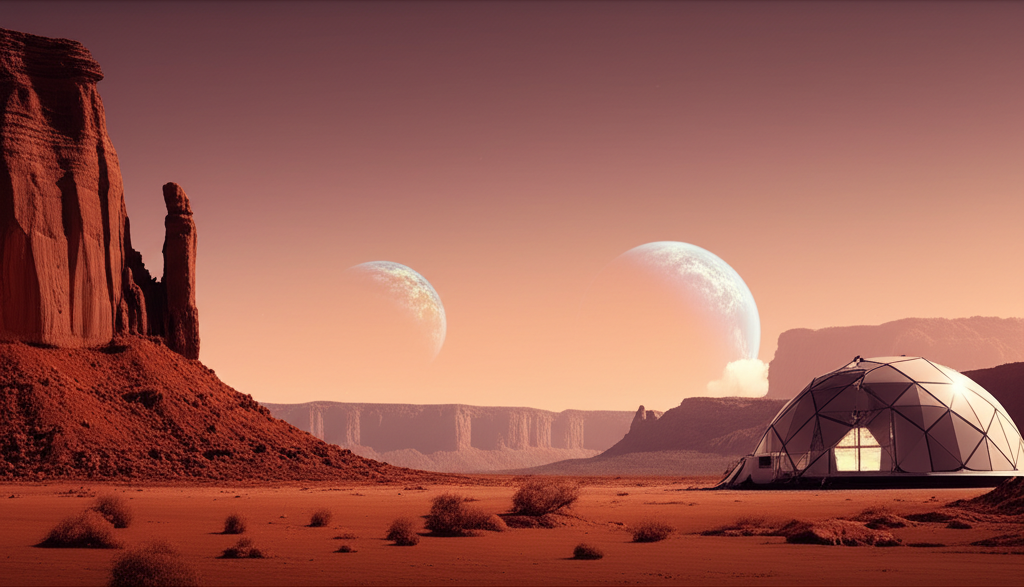
Why do we look to the stars with such longing, and why does Mars, in particular, captivate our imagination as humanity’s potential future home? The answer isn’t singular but a mosaic of scientific necessity, existential precaution, and an unyielding spirit of exploration. As our technological capabilities advance and the challenges on Earth grow more complex, the Red Planet increasingly appears not merely as a distant curiosity but as a viable, perhaps even vital, next step for civilization.
The Earthly Imperatives: Why Seek a Second Home?
Our profound connection to Earth is undeniable, yet a pragmatic look at our planet’s future reveals compelling reasons to diversify our species’ presence. Climate change, resource depletion, and growing geopolitical tensions are pressing concerns that, while solvable, demand immense global cooperation. Beyond these self-inflicted wounds, Earth faces cosmic threats like asteroid impacts, supervolcanic eruptions, and gamma-ray bursts – events that, though rare, could catastrophicly alter life as we know it.
The fundamental why here is survival. Placing all of humanity’s eggs in one planetary basket introduces an unacceptable level of risk. Establishing an independent, self-sustaining civilization on Mars would provide an invaluable planetary ‘backup drive,’ significantly increasing the long-term resilience and ultimate survival prospects of the human species. It’s not about abandoning Earth, but about safeguarding humanity’s future against unforeseeable calamities and ensuring the continuity of our consciousness and culture.
The Alluring Call of the Red Planet: Why Mars?
Among the cosmic options, Mars stands out for several critical reasons that make it the most promising candidate for future human settlement.
Proximity: Mars is our closest planetary neighbor that is remotely habitable. While still a significant journey, its relative closeness (a few months’ travel depending on orbital alignment) makes it far more accessible than, say, the moons of Jupiter or Saturn.
Resources for Self-Sustainability: One of the greatest advantages of Mars is its potential for In-Situ Resource Utilization (ISRU).
Water Ice: Abundant water ice has been confirmed at the poles and beneath the surface, crucial for drinking, agriculture, and – vitally – for producing oxygen (for breathing) and hydrogen (for rocket fuel).
Atmosphere: Mars’ thin atmosphere, composed primarily of carbon dioxide, is a valuable resource. Technologies are being developed to convert CO2 into oxygen and methane fuel.
Minerals: Martian soil contains essential elements like iron, silicon, aluminum, and sulfur, which can be extracted and processed for construction materials, tools, and electronics, moving towards self-sufficiency.
A “Familiar” Day: A Martian day (sol) is remarkably similar to an Earth day, lasting approximately 24 hours and 37 minutes. This near-synchronicity would simplify circadian rhythms for settlers, aiding in psychological adjustment and work-rest cycles.
Gravity: With about one-third of Earth’s gravity, Mars offers a more manageable environment than the zero-G of space or the microgravity of the Moon. While low gravity poses challenges for human physiology (bone density, muscle mass), it is significantly better than prolonged weightlessness and could be a more sustainable long-term environment for human life and development.
Historical Habitable Conditions: Scientific evidence points to a past Mars with liquid water flowing across its surface, a thicker atmosphere, and potentially habitable conditions. This raises profound scientific questions and offers clues for understanding how to adapt the planet for our future.
Constructing a Future: Overcoming the Challenges
Establishing a permanent human presence on Mars is undoubtedly an monumental undertaking, fraught with challenges. The atmosphere is too thin to breathe and offers little protection from solar and cosmic radiation. Surface temperatures are frigid, and dust storms can engulf the planet.
However, these are problems for which humanity is actively devising solutions:
Radiation Shielding: Habitats can be constructed underground or covered with regolith (Martian soil) and water to shield against harmful radiation.
Life Support Systems: Closed-loop systems will recycle air and water, minimizing waste and maximizing efficiency.
Energy Production: Nuclear fission reactors, solar panels, and potentially geothermal energy could provide the power necessary for settlements.
Terraforming (Long-term Vision): While centuries away, the concept of gradually altering Mars’ environment to make it more Earth-like – by thickening its atmosphere, raising temperatures, and potentially restoring liquid water – remains a distant, inspiring goal.
The Vision Beyond Survival: Why Ponder Mars?
Beyond mere survival, the colonization of Mars represents a profound leap for humanity. It offers an unparalleled opportunity for scientific discovery, pushing the boundaries of our knowledge about planetary formation, the origins of life, and the potential for life beyond Earth.
Mars colonization would also be a catalyst for technological innovation, driving breakthroughs in propulsion, life support, robotics, artificial intelligence, and material science that would benefit life on Earth. It would expand our economic sphere, creating new industries and economies centered around space resources and off-world living.
Moreover, the endeavor of settling Mars could serve as a unifying project for humanity. Facing such a grand challenge together could inspire global cooperation, foster a shared sense of purpose, and elevate our perspective beyond terrestrial conflicts. It represents the ultimate expression of our innate drive to explore, to discover, and to build a better future.
Conclusion: A Bold Step for Humanity
The question of why Mars has evolved from philosophical musing to strategic imperative. It is a response to the fragility of our existence on a single planet, an embrace of scientific opportunity, and a testament to the enduring human spirit of exploration and innovation. Mars is not just another desolate world; it is a canvas upon which humanity can paint its next chapter – a place where we can learn not just to survive, but to thrive, ensuring a vibrant and expansive future for generations to come. The ultimate future home for humanity is not a destination, but a journey of audacious vision and relentless determination.
0 Comments