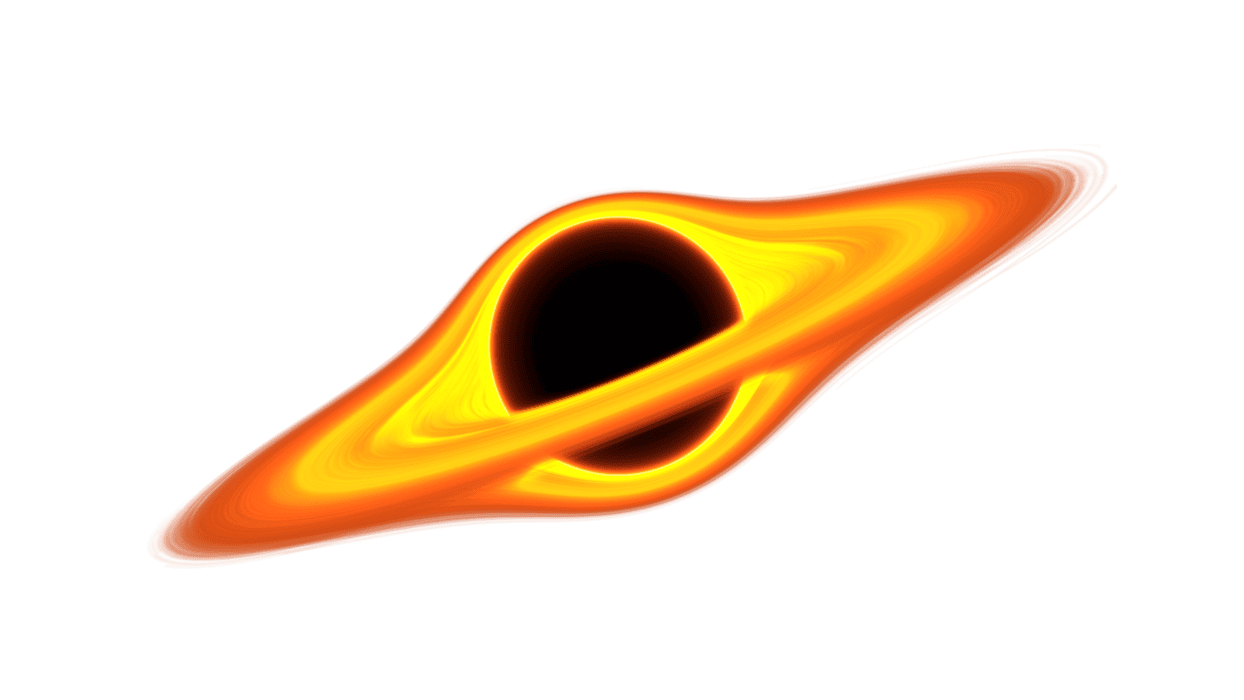
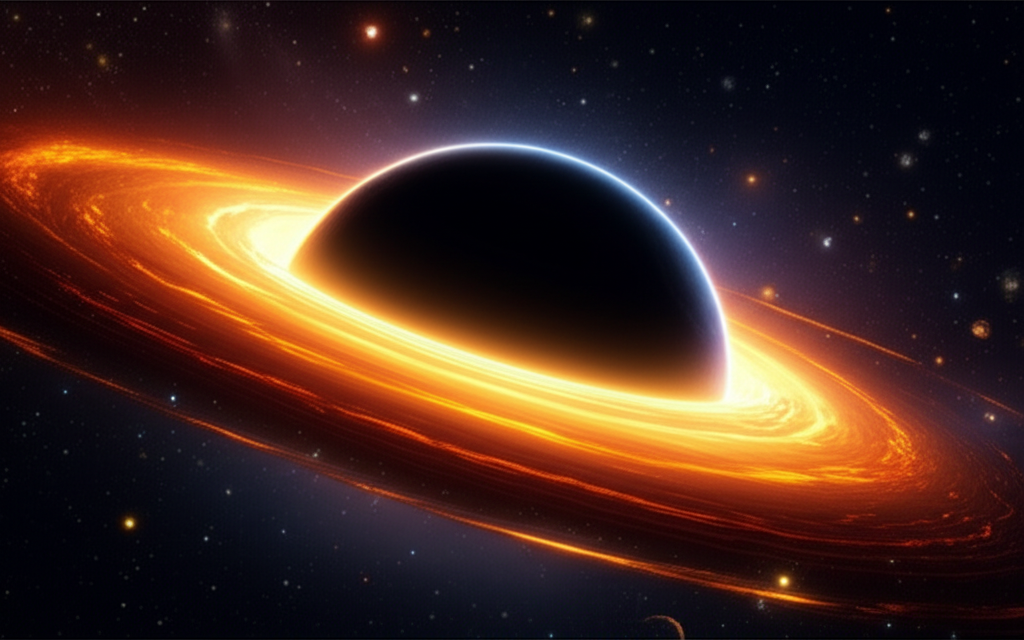
What happens in a black hole? It’s a question that has captivated scientists and stargazers alike for decades, a journey into the most extreme environments in the universe where the known laws of physics seem to break down. These cosmic behemoths are not merely empty voids, but regions of spacetime where gravity is so overwhelmingly powerful that nothing – not even light – can escape their clutches. Understanding what transpires within their enigmatic depths requires venturing beyond the familiar, into concepts of infinite density, warped spacetime, and the very fabric of reality pushed to its limits.
What Exactly Is a Black Hole?
Before delving into the “what happens,” it’s crucial to grasp what a black hole fundamentally is. Imagine a dying star, many times more massive than our Sun. When it exhausts its nuclear fuel, its core collapses under its own immense gravity. If the remnant core is massive enough, this collapse continues indefinitely, crushing all its matter into an infinitesimally small, incredibly dense point called a singularity. This singularity is the heart of a black hole, possessing such an extreme gravitational pull that it warps the very fabric of spacetime around it.
It’s this warped spacetime that defines the black hole, particularly a boundary called the event horizon. This is not a physical surface, but rather a theoretical “point of no return.” Cross it, and escape is impossible. The escape velocity – the speed required to break free from gravity – at the event horizon exceeds the speed of light itself.
What Happens at the Event Horizon?
The event horizon is the threshold of no return, a one-way membrane into the unknown. From an outside observer’s perspective, watching an object fall into a black hole would be a bizarre experience. As the object approaches the event horizon, time for it would appear to slow down drastically relative to the distant observer. Its light would redshift, meaning it would appear to grow dimmer and redder until it effectively freezes and fades away just at the edge, never truly crossing in the observer’s frame of reference. This phenomenon, known as gravitational time dilation, is a profound consequence of Einstein’s theory of general relativity.
However, for the object or astronaut actually falling in, the experience is quite different. They would not notice anything physically special as they cross the event horizon itself. There’s no sudden jolt or wall. Instead, they simply continue their journey inward, unaware that the universe they once knew is now irrevocably beyond their reach. The true drama unfolds after crossing this cosmic threshold.
Spaghettification: The Ultimate Stretch
For anything falling into a stellar-mass black hole (those formed from collapsed stars), the gravitational forces accelerate rapidly and unevenly. This leads to a terrifying process known as spaghettification. Imagine falling feet-first into a black hole. The gravitational pull on your feet, being closer to the singularity, would be drastically stronger than the pull on your head. Simultaneously, the sides of your body would be squeezed inward by the converging gravitational field.
The result is a horrifying stretch and tear: your body would be stretched lengthwise like a noodle, while simultaneously being compressed sideways. Every atom, molecule, and cell would be pulled apart, elongated into a thin stream of particles. It’s an agonizing and swift disintegration, long before reaching the singularity itself.
Interestingly, this violent spaghettification is less pronounced when falling into a supermassive black hole, like the one at the center of our galaxy, Sagittarius A*. Because these black holes are vastly larger, their event horizons are much wider, meaning the gravitational gradient across a human body is far less extreme at the point of crossing. An unfortunate explorer might cross the event horizon of a supermassive black hole without feeling anything unusual, only to face spaghettification much deeper inside, closer to the singularity, where the tidal forces eventually become overwhelming.
What Lies Beyond the Event Horizon?
Once past the event horizon, and assuming one survives spaghettification for long enough, the trajectory changes fundamentally. All paths lead inward, towards the singularity. There is no escaping, no turning back, no possible way to even stand still relative to the black hole’s center. Spacetime itself is so severely distorted that “forward” in space literally points towards the singularity.
At the very heart lies the singularity—a point of infinite density and zero volume. Here, our current understanding of physics completely breaks down. General relativity predicts this singularity, but it’s a point where its equations no longer apply. This suggests that a more comprehensive theory, one that unifies general relativity with quantum mechanics (a theory of quantum gravity), is needed to truly describe what happens at this ultimate cosmic convergence. Some theories propose that singularities might be gateways to other dimensions or universes, or perhaps that quantum effects prevent infinite density, smoothening out the singularity into a fuzzier, extreme region.
The Mystery of Hawking Radiation and Evaporation
Despite their reputation as cosmic devourers, black holes are not entirely “black” in the long run. Stephen Hawking famously theorized that black holes slowly leak energy in the form of Hawking radiation. This mind-bending concept stems from quantum fluctuations near the event horizon, where pairs of “virtual” particles and anti-particles are constantly popping into and out of existence.
Normally, these pairs annihilate each other instantly. However, if one particle of a pair falls into the black hole and the other escapes, the escaping particle carries away a tiny bit of the black hole’s mass-energy. Over unimaginable timescales, this mass loss means black holes are slowly evaporating. Tiny black holes would evaporate quickly in a burst of energy, while stellar-mass black holes would take far longer than the current age of the universe. Supermassive black holes will take even longer still, effectively immortal on cosmic timescales. The evaporation process also hints at the famous information paradox, questioning whether information swallowed by a black hole is truly lost forever or somehow preserved in the Hawking radiation.
Conclusion: A Cosmic Enigma
What happens in a black hole is a tale of extreme gravity, warped spacetime, and the limits of human knowledge. From the deceptively calm crossing of the event horizon to the violent process of spaghettification and the ultimate fate at the mysterious singularity, black holes push our understanding of physics to its breaking point. They are not merely destructive forces but also crucial components of galactic evolution, influencing the formation and dynamics of stars and galaxies. As our telescopes and theoretical models become more sophisticated, the stunning secrets hidden within these cosmic enigmas continue to unravel, promising even more profound insights into the very nature of the universe.
0 Comments