
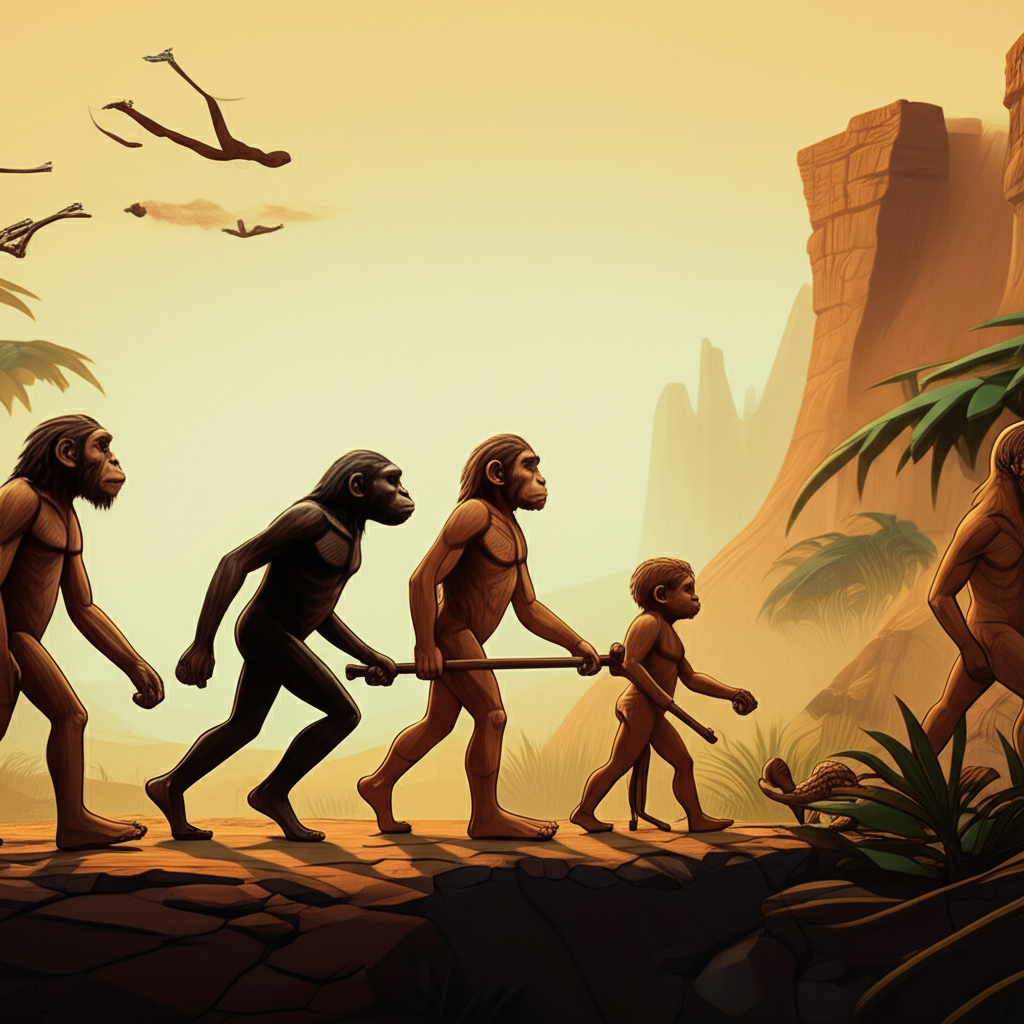
How did humans evolve from their ape-like ancestors to the complex, tool-making, culture-creating beings we are today? It’s a question that has captivated humanity for centuries, and recent stunning discoveries have continually reshaped and enriched our understanding of this epic journey. From ancient bones unearthed in dusty plains to revolutionary genetic insights, each new find adds another vital piece to the intricate puzzle of human origins, revealing a story far more complex and fascinating than previously imagined. This article delves into some of these groundbreaking discoveries and the profound impact they’ve had on our view of who we are and where we come from.
The Dawn of Bipedalism: Standing Tall
One of the most defining moments in human evolution was the transition to bipedalism – walking upright on two legs. This wasn’t a sudden leap but a gradual adaptation, and fossil evidence has provided astonishing glimpses into this pivotal change. Discoveries like “Lucy,” a remarkably complete skeleton of Australopithecus afarensis found in Ethiopia in 1974, dramatically confirmed that our ancestors were walking upright over 3 million years ago, long before significant brain expansion or complex tool use. Lucy’s pelvis and leg bones clearly indicate a bipedal gait, while her relatively small brain size highlights the sequence of human evolutionary traits.
Even older finds push this story further back. Orrorin tugenensis, discovered in Kenya, dates back around 6 million years, and the structure of its femur suggests it too was bipedal. Sahelanthropus tchadensis, found in Chad and dated to approximately 7 million years ago, offers tantalizing clues from an even earlier period, near the divergence point from the chimpanzee lineage. Its foramen magnum (the hole at the base of the skull where the spinal cord connects) is positioned more forward than in apes, hinting at an upright posture. These early discoveries are critical in understanding how fundamental adaptations like bipedalism set the stage for all subsequent human evolution, freeing the hands for other tasks and potentially aiding in foraging, vigilance, and thermoregulation.
Tools, Fire, and Expansion: The Rise of Homo
The emergence of the genus Homo marks a significant leap in cognitive ability and behavioral complexity. Early members like Homo habilis (the “handy man”), dating back over 2 million years, are famous for their association with the first stone tools – simple choppers and flakes known as Oldowan tools. These tools represent a cognitive shift, demonstrating the ability to conceptualize a tool, select appropriate raw materials, and skillfully modify them for specific uses like scavenging meat or processing plants. The archaeological sites revealing these tool assemblages, often alongside animal bones bearing cut marks, paint a vivid picture of early hominins actively shaping their environment and diet.
Then came Homo erectus, a truly revolutionary species that emerged around 1.9 million years ago. Homo erectus was the first hominin to leave Africa, spreading across Asia and potentially into Europe. Its longer legs and more human-like proportions suggest a more efficient bipedalism, suitable for long-distance travel. Perhaps the most stunning discovery associated with Homo erectus is the evidence of controlled fire. While direct evidence is scarce and debated for the earliest periods, sites like Wonderwerk Cave in South Africa contain scorched bones and ash deposits dating back a million years, hinting at this transformative control. The mastery of fire would have provided warmth, protection from predators, enabled cooking (making food more digestible and nutritious), and fostered social gatherings, fundamentally altering early human life and survival strategies. Learning how to harness fire was a game-changer.
Complex Thought and Cultural Flourishing
As the human lineage progressed, brain size increased, leading to more sophisticated behaviors, symbolic thought, and distinct cultural practices. Neanderthals (Homo neanderthalensis), our close cousins who thrived in Eurasia for hundreds of thousands of years, have been subject to numerous captivating discoveries. Far from the brutish image once portrayed, archaeological evidence now reveals Neanderthals were skilled hunters, capable of caring for their sick and elderly, burying their dead, and even creating rudimentary symbolic artifacts like shell beads or pigments. Their sophisticated Mousterian tool technology, involving prepared core methods, demonstrates advanced planning and craftsmanship.
The story of modern humans, Homo sapiens, is equally remarkable. Originating in Africa roughly 300,000 years ago, our species developed an unparalleled capacity for innovation, abstract thought, and complex social structures. Stunning discoveries in caves like Lascaux and Chauvet in France reveal exquisite parietal art dating back tens of thousands of years, showcasing a profound human need for expression and storytelling. Decorated tools, personal ornaments, and elaborate burials all point to a rich inner world and sophisticated cultural systems that characterize our species.
The Genetic Revolution: Rewriting Our Story
Perhaps some of the most profound “stunning discoveries” of the last few decades come not from digging in the dirt, but from analyzing DNA. The advent of ancient DNA (aDNA) analysis has revolutionized our understanding of human evolution, allowing scientists to sequence genomes from long-dead hominins. The complete Neanderthal genome, for instance, revealed that modern humans of non-African descent carry a small percentage of Neanderthal DNA, indicating interbreeding events between Homo sapiens and Neanderthals as our ancestors migrated out of Africa.
Even more recently, the discovery of the Denisovan hominins, identified initially solely through DNA extracted from a finger bone found in a Siberian cave, illustrates the immense power of genetics. Denisovan DNA is also found in modern human populations, particularly in Southeast Asia and Oceania, adding another branch to the complex human family tree and showing how intricate the web of ancestral connections truly is. These genetic insights not only confirm broad migration patterns but also highlight the dynamic interactions between different human groups over vast stretches of time, continuously refining our understanding of diversification, adaptation, and mixing.
The Ongoing Quest: Ever-Unfolding Stories
The quest to understand human evolution is far from over. Each year brings new fossil finds, more refined dating techniques, and increasingly powerful genetic analyses. Discoveries like Homo naledi in the Rising Star Cave system in South Africa, which challenges assumptions about burial practices and brain size, serve as a potent reminder that the story of human origins is a vibrant, continuously unfolding narrative. The journey of human evolution is a testament to resilience, adaptability, and the remarkable capacity for change across millions of years, an awe-inspiring saga of discovery that truly defines what it means to be human.
0 Comments