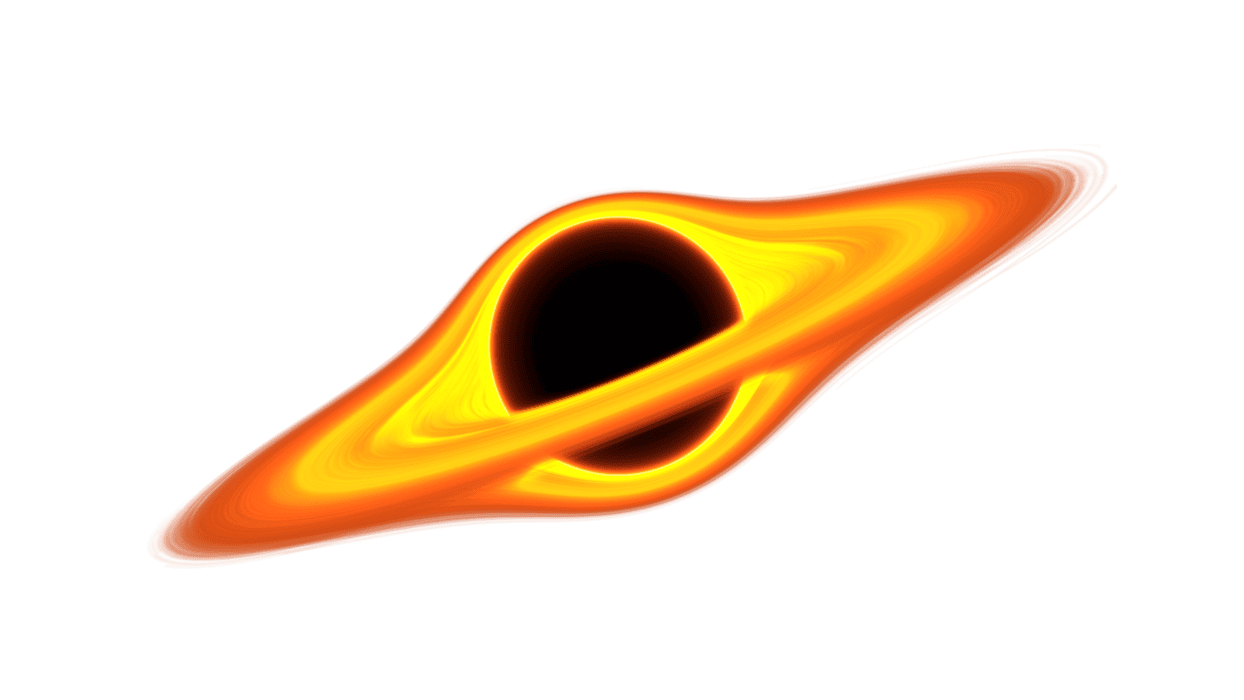

What lies beyond the event horizon of a black hole? It’s a question that has captivated scientists and space enthusiasts for decades, inspiring countless theories, scientific expeditions, and even science fiction narratives. These cosmic behemoths, born from the spectacular collapse of massive stars, represent the ultimate frontiers of physics, where the known laws of the universe bend, break, and perhaps even cease to exist. While we can’t directly observe their interiors, theoretical physics and astronomical observations paint a mesmerizing, albeit terrifying, picture of the extreme secrets they guard.
The Event Horizon: The Ultimate Boundary
To begin understanding what happens inside, we must first grasp the concept of the event horizon. Imagine an invisible spherical boundary surrounding the black hole’s core. This isn’t a physical surface, but rather a point of no return. Beyond this boundary, the gravitational pull is so immense that nothing – not even light, the fastest entity in the universe – can escape.
From an external observer’s perspective, an object approaching the event horizon would appear to slow down, its light reddening and dimming until it seemingly freezes and fades away forever. This is due to extreme gravitational time dilation – time literally stretches near a black hole. For the object itself, however, the journey continues rapidly across the event horizon. Once crossed, escape is impossible, and the object’s fate is sealed, hurtling inexorably towards the black hole’s heart.
Spaghettification: The Cosmic Noodle Machine
What happens to matter as it falls in? The journey into a black hole is anything but gentle. The first dramatic effect an object experiences is known as “spaghettification.” This unsettling term describes the immense tidal forces at play. Imagine stretching a piece of spaghetti: one end pulls harder than the other. Similarly, as an object approaches a black hole, the gravitational pull on the part of the object closer to the black hole is significantly stronger than the pull on the part further away.
For a human or a spaceship, this means your feet (if falling feet-first) would be pulled with vastly greater force than your head. The difference in gravitational pull would stretch you vertically while compressing you horizontally, elongating your body into a long, thin strand – much like a noodle. These forces are so extreme that they would tear apart even the most robust materials, pulverizing planets, stars, and everything in between into a stream of fundamental particles. Only the tiniest black holes would spaghettify you before crossing the event horizon; for supermassive black holes, you might cross the horizon intact, only to be spaghettified moments later within.
The Singularity: Where Physics Breaks Down
At the very heart of every black hole lies the singularity – a point (or ring, for rotating black holes) of infinite density and zero volume. This is where all the mass of the black hole is concentrated. What exactly is a singularity? It’s a realm where our current understanding of physics, particularly Einstein’s theory of general relativity, utterly fails.
General relativity, which beautifully describes gravity on cosmic scales, predicts that at the singularity, spacetime curvature becomes infinite. This means that concepts like space, time, and even the fundamental forces we understand cease to have meaning. It’s a region beyond the scope of known science, hinting at the need for a unified theory of quantum gravity to truly describe its nature. Some theories propose that the singularity might not be a point but a region constrained by quantum effects, or even a gateway to another universe, though these remain highly speculative.
The Information Paradox: A Cosmic Mind-Bender
One of the most profound puzzles arising from black hole physics is the “information paradox.” In quantum mechanics, information – referring to the specific state of particles and their properties – is never truly lost. However, if anything that falls into a black hole is crushed into a singularity, and the black hole eventually evaporates (as predicted by Hawking Radiation), what happens to all that information? Does it simply vanish from the universe?
Stephen Hawking initially argued that information was indeed lost, but later revised his stance, suggesting it might be encoded on the event horizon or somehow escape during evaporation. The paradox highlights a fundamental clash between general relativity and quantum mechanics, pushing physicists to develop new theoretical frameworks to reconcile these two pillars of modern physics. Resolving it could offer unprecedented insights into the fundamental nature of reality itself.
Hawking Radiation: Black Holes Aren’t Forever
Despite their terrifying reputation as cosmic devourers, black holes are not truly eternal. Stephen Hawking theorized that black holes slowly evaporate over incredibly long timescales through a process now known as Hawking Radiation. This isn’t light escaping the black hole itself, but rather a quantum mechanical phenomenon occurring just at the edge of the event horizon.
The vacuum of space is not truly empty; it’s constantly teeming with “virtual” particle-antiparticle pairs that spontaneously pop into existence and then immediately annihilate each other. Near the event horizon, if one particle of a pair falls into the black hole, the other can escape, carrying away a tiny bit of the black hole’s energy in the form of radiation. Over eons, this slow leakage of energy causes the black hole to shrink and eventually completely evaporate, leaving nothing behind (or perhaps, as the Information Paradox suggests, leaving some trace of the information it consumed). The smallest black holes would evaporate relatively quickly, while supermassive black holes could take trillions upon trillions of years – far longer than the current age of the universe.
Unraveling the Ultimate Mystery
The secrets held within black holes represent the ultimate frontier of human understanding. From the mind-bending time dilation and destructive spaghettification to the enigmatic singularity and the profound information paradox, these cosmic titans challenge our very perception of space, time, and matter. While direct observation of their interiors remains impossible, the relentless pursuit of theoretical physics, combined with incredible astronomical observations like those from the Event Horizon Telescope, continues to peel back the layers of this profound cosmic mystery. Each new discovery promises not only to illuminate the nature of black holes but also to offer deeper insights into the fundamental laws governing our universe.
0 Comments