
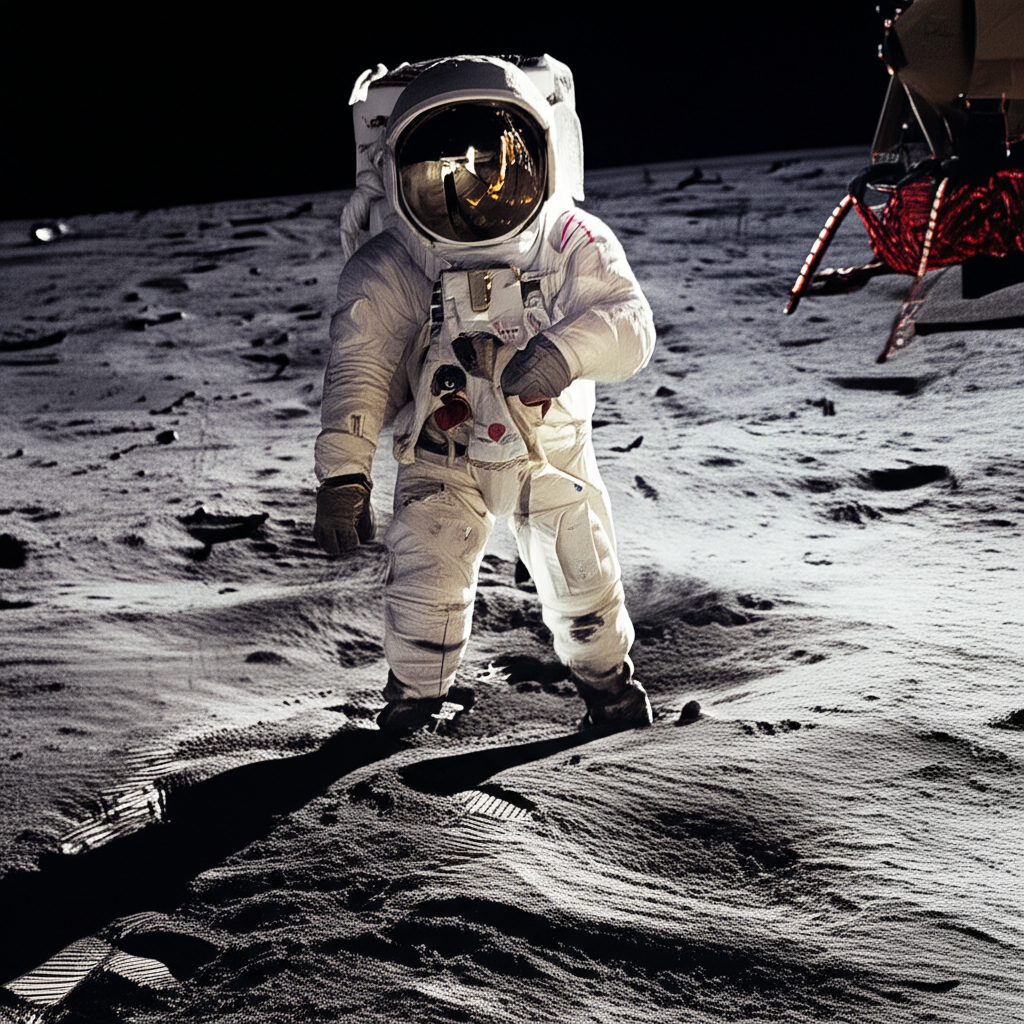
The moon landing, precisely 55 years ago, remains etched in humanity’s collective memory as one of its most audacious and inspiring achievements. It was a moment that transcended geopolitical divides, stopping the world in its tracks to witness what had previously been confined to the realm of science fiction. The journey of Apollo 11, from a launchpad in Florida to the dusty surface of the Moon and back, is more than just a historical event; it is an incredible testament to human ingenuity, perseverance, and the boundless spirit of exploration.
The Dawn of an Era: The Space Race
In the mid-20th century, the world was locked in a fierce ideological battle known as the Cold War. This rivalry extended beyond political and military spheres, manifesting prominently in the Space Race between the United States and the Soviet Union. The Soviets kicked off this race with stunning successes, launching Sputnik 1, the first artificial satellite, in 1957, followed by Yuri Gagarin, the first human in space, in 1961. These victories profoundly rattled American confidence, creating a sense of urgency.
It was against this backdrop that, in May 1961, President John F. Kennedy issued a historic challenge to a joint session of Congress: to commit the nation to “landing a man on the Moon and returning him safely to the Earth” before the decade was out. This was an extraordinarily ambitious goal, given that at the time, America had barely sent a human into orbit. Kennedy’s declaration injected a powerful, unifying purpose into the nascent American space program, mobilizing unprecedented resources and intellectual capital towards an seemingly impossible dream.
The Apollo Program: A Monumental Effort
Meeting Kennedy’s challenge required a monumental effort, far surpassing any engineering project ever undertaken. The Apollo program, a series of human spaceflight missions, was designed to systematically overcome the myriad challenges of lunar travel. It built upon the foundational experiences of the Mercury and Gemini programs, which refined spacecraft design, rendezvous techniques, and extended human endurance in space.
The sacrifices were significant. The program faced setbacks, most tragically the Apollo 1 fire in 1967, which claimed the lives of astronauts Gus Grissom, Ed White, and Roger Chaffee during a launch rehearsal. This devastating incident forced NASA to re-evaluate and redesign critical components, prioritizing astronaut safety and enhancing the reliability of every system. These painful lessons ultimately forged a stronger, more resilient program, meticulously preparing spacecraft and crews for the demanding journey ahead. Thousands of scientists, engineers, technicians, and support staff across the nation dedicated their lives to this singular objective, pushing the boundaries of technology and human knowledge.
The Journey to Tranquility Base
On July 16, 1969, the world watched in awe as the mighty Saturn V rocket, the most powerful machine ever built, propelled Apollo 11 skyward from Launch Complex 39A at Florida’s Kennedy Space Center. Aboard were three extraordinary astronauts: Commander Neil Armstrong, Lunar Module Pilot Buzz Aldrin, and Command Module Pilot Michael Collins. Their mission: to make history.
After a three-day journey through space, Apollo 11 entered lunar orbit. On July 20, Armstrong and Aldrin entered the Lunar Module, nicknamed “Eagle,” while Collins remained in orbit aboard the Command Module, “Columbia,” serving as their critical link to Earth. The descent to the lunar surface was fraught with tension and peril. Navigational errors, unexpected terrain, and dwindling fuel supplies nearly forced an abort. With only seconds of fuel remaining, Armstrong, demonstrating incredible skill and composure, manually piloted the Eagle past a boulder-strewn crater to a clear landing spot. “Houston, Tranquility Base here,” he radioed. “The Eagle has landed.”
The First Steps: A Giant Leap for Humankind
Hours after landing, at 10:56 PM EDT on July 20, 1969, Neil Armstrong descended the ladder of the Eagle. As his left foot touched the lunar dust, he uttered words that would forever echo through history: “That’s one small step for [a] man, one giant leap for mankind.” Millions around the globe, huddled around televisions and radios, shared in this breathtaking moment. Soon after, Buzz Aldrin joined him on the lunar surface.
For approximately two and a half hours, the two astronauts explored their immediate surroundings at Tranquility Base. They collected lunar rock and soil samples, deployed scientific instruments, and famously planted the American flag. Their movements, clumsy in the lower lunar gravity, were a mesmerizing spectacle. The images transmitted back to Earth—the gray, desolate landscape under a black sky, with the blue marble of Earth hanging in the distance—were both alien and profoundly humbling. They spoke to President Richard Nixon via phone, a surreal conversation spanning hundreds of thousands of miles, marking humanity’s first direct contact from another celestial body.
The Return Home and Enduring Legacy
After their historic moonwalk, Armstrong and Aldrin ascended from the Moon’s surface in the Eagle’s upper stage, successfully docking with Columbia in lunar orbit, where Michael Collins had patiently awaited their return. The three astronauts then began their perilous journey back to Earth, culminating in a successful splashdown in the Pacific Ocean on July 24, 1969. They were met by jubilant crowds and national heroes, undergoing a brief quarantine period to ensure they had not brought back any unknown lunar microbes.
The ripples of the moon landing extended far beyond its immediate triumph. Scientifically, the 382 kilograms of lunar samples brought back by Apollo missions revolutionized our understanding of the Moon’s geology, formation, and its relationship to Earth. Technologically, the program spurred innovations in computing, materials science, and telecommunications that continue to benefit society today. Culturally, it was a moment of unparalleled global unity and inspiration, demonstrating what humanity could achieve when united by a common, ambitious purpose. While some conspiracy theories persist, attempting to deny the reality of the landing, the overwhelming evidence, including independent analysis of lunar samples and satellite imagery, firmly supports the historical fact. The moon landing solidified human conviction that no frontier is too distant to explore, no challenge too great to overcome.
The journey to the Moon was more than a singular mission; it was a testament to the power of human ambition. It remains a powerful symbol of our capacity for innovation, courage, and the insatiable human desire to look up at the stars and reach for them. The epic story of the moon landing continues to inspire new generations to dream big and push the boundaries of what is possible, reminding us that the grandest adventures often lie just beyond our current horizon.
Wow that was strange. I just wrote an really long comment but after I
clicked submit my comment didn’t appear. Grrrr…
well I’m not writing all that over again. Regardless, just wanted to
ssay superb blog!