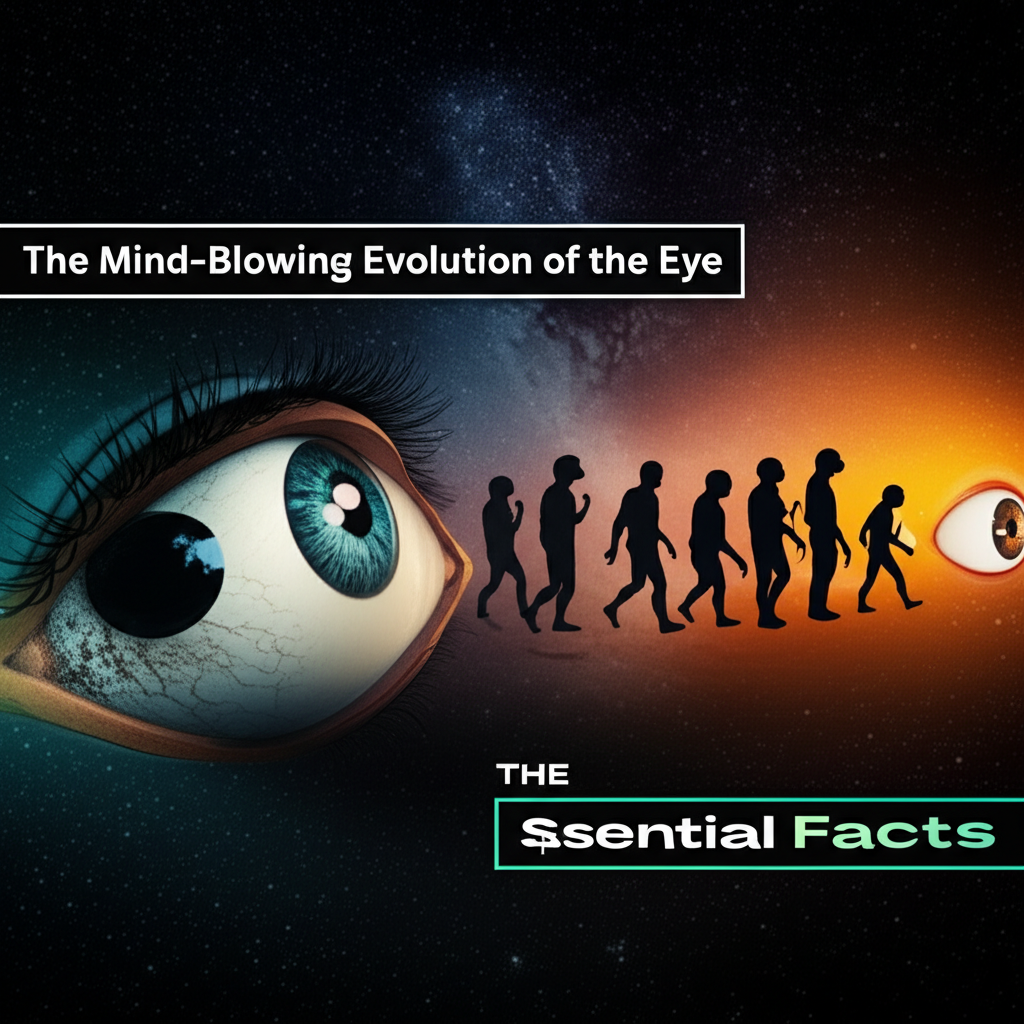
The Mind-Blowing Evolution of the Eye: Essential Facts
The journey of the eye, from a humble light-sensitive patch to the intricate visual organs we possess today, is one of the most astonishing stories in natural history. It’s a testament to the power of natural selection, demonstrating how even seemingly irreducibly complex structures can arise through a series of small, beneficial modifications over vast stretches of time. Understanding this millennia-spanning narrative not only illuminates the mechanics of vision but also offers profound insights into the very nature of evolution itself. Far from being a sudden invention, the eye’s development was a gradual, step-by-step process, driven by the intense competition for resources and survival in ancient environments.
The Earliest Glimmers: Light-Sensitive Spots
Life on Earth began without sight. For billions of years, organisms navigated their world through touch, smell, and chemical senses. The first ancestors of eyes were not eyes at all, but simple single-celled organisms equipped with light-sensitive proteins called opsins. These tiny photoreceptors could merely detect the presence or absence of light, allowing primitive organisms to distinguish day from night or find optimal light conditions for photosynthesis. This basic ability to sense light, even without forming an image, provided a significant survival advantage, enabling movement towards food or away from predators.
Imagine a flatworm with nothing more than a few light-sensitive cells clustered together. These “eyespots” couldn’t see shapes or colours, but they could detect shadows. If a predator cast a shadow, the flatworm could instinctively react, perhaps by moving away. This rudimentary ability marked the critical first step: the power to differentiate light from dark.
Pinhole Advantage: Gaining Direction
The next crucial step in the mind-blowing evolution of the eye involved creating a depression or pit around these light-sensitive cells. This concavity offered a vital advantage: directionality. By allowing light to enter from only a limited angle, these “optic cups” could roughly determine the direction a light source was coming from.
A wonderful example of this evolutionary stage is the nautilus, a living fossil with simple pinhole eyes. Its eyes lack a lens, relying instead on a small opening that functions much like a camera obscura. This design provides a surprisingly clear, albeit dim, image. While not perfect, it’s a massive leap from merely detecting light, enabling the organism to perceive the general shape and movement of objects in its environment. Such an eye could help differentiate between a distant predator and a harmless shadow, or locate food with greater precision.
The Invention of the Lens: Sharpening the Focus
The real breakthrough came with the development of a transparent covering over the pinhole, which eventually thickened and specialized into a lens. This lens had the incredible ability to focus incoming light onto the photoreceptor cells, creating a much sharper, brighter image than a pinhole eye ever could. This innovation was a game-changer, dramatically enhancing visual acuity and opening up entirely new ecological niches.
The evolution of the lens allowed for two major branches of eye development:
1. Compound Eyes: Characterized by multiple small optical units called ommatidia, each with its own lens and photoreceptor. These eyes are fantastic at detecting motion and offer a wide field of view, making them common in insects and crustaceans. Think of a fly’s faceted eye, which creates a mosaic image.
2. Camera-Type Eyes: Found in vertebrates (like humans) and cephalopods (like octopuses and squids), these eyes have a single large lens that focuses light onto a retina, much like a camera. This design offers high resolution and excellent depth perception. Interestingly, cephalopod eyes evolved entirely independently from vertebrate eyes, showcasing convergent evolution – distinct species arriving at similar solutions to complex problems.
The Cambrian Explosion: Vision’s Impact
The emergence of sophisticated eyes around 540 million years ago, during the geological period known as the Cambrian Explosion, is believed to have been a major catalyst for the rapid diversification of life forms. Suddenly, predators could actively hunt, and prey could actively evade. The ability to see sparked an evolutionary arms race, driving the rapid development of new body plans, defence mechanisms, and behaviours. Organisms that could see better, or hide better from those that could see, were more likely to survive and reproduce.
This period saw the sudden appearance of most major animal phyla, many of which sported elaborate eyes. It’s truly a testament to how crucial vision became in shaping the trajectory of life on Earth.
Beyond the Visible: Diverse Visual Worlds
Evolution didn’t stop at merely seeing what we call the “visible” spectrum. Different species developed eyes tailored to their specific environments and needs:
UV Vision: Many insects and birds can see in ultraviolet light, revealing patterns on flowers or plumage that are invisible to humans.
Infrared Vision: Some snakes possess pit organs that detect infrared radiation (heat), allowing them to “see” warm-blooded prey in total darkness.
Multispectral Vision: Some species, like the mantis shrimp, possess incredibly complex compound eyes with up to 12 different types of photoreceptors, allowing them to perceive an extraordinary range of colours and polarized light patterns. This extreme vision is still not fully understood by scientists.
Night Vision: Animals active at night, like owls, have greatly enlarged pupils and more rod cells in their retinas to maximize light capture, enabling them to see in extremely low light conditions.
The Human Eye: A Masterpiece of Compromise
Our own camera-type eyes are marvels of biological engineering. With millions of photoreceptor cells (rods for low light and cones for colour vision), a sophisticated lens that can adjust its focus, and a complex neural network that processes visual information, they allow us to perceive a rich, detailed world. Yet, even the human eye has its quirks, like the blind spot where the optic nerve connects to the retina – a minor imperfection that evolution found acceptable given the overall benefits.
Debunking “Irreducible Complexity”
The eye’s gradual evolution stands as a powerful counter-argument to the concept of “irreducible complexity,” which posits that some biological structures are too complex to have evolved incrementally. The step-by-step development from a simple light-sensitive patch, to a pit, to a pinhole, to a lens, and then to various specialized forms, clearly demonstrates that each intermediate stage offered a selective advantage. Each modification, no matter how small, improved an organism’s ability to survive and reproduce, paving the way for the next level of complexity.
In conclusion, the evolution of the eye is not just an essential fact of biology; it’s an epic saga of incremental innovation. From a rudimentary ability to sense photons, life developed the astonishing capacity to perceive intricate details, react to movement, and navigate complex environments. This incredible journey underscores the inventive power of natural selection and its profound impact on shaping the astonishing diversity of vision we see across the animal kingdom today.
0 Comments